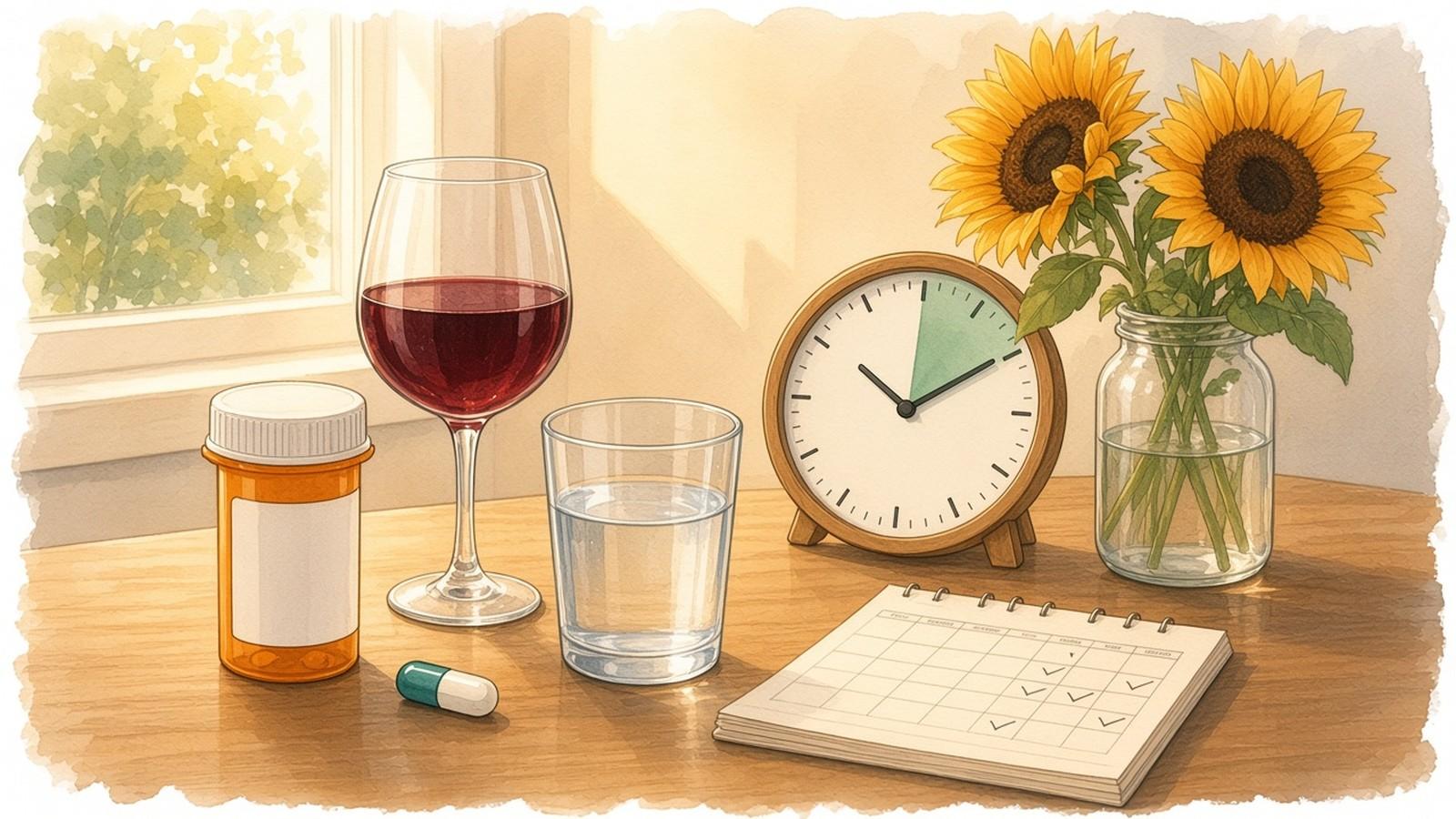
The Sinclair Method is designed for people who are not initially abstinent. Rather than requiring abstinence before treatment begins, it uses naltrexone around times you plan to drink as part of a drinking-reduction strategy.
Some alcohol-treatment approaches emphasize abstinence from the outset. Other approaches, naltrexone among them, can cut heavy drinking without requiring abstinence before medication is started. The appropriate goal, reduction or abstinence, depends on your medical circumstances, treatment goals, and risk of alcohol withdrawal.
Why adherence to the prescribed schedule matters#
In Sinclair-style treatment, adherence to the prescribed targeted schedule is considered important. Clinical trials have found benefits from taking naltrexone in anticipation of high-risk drinking situations, but the evidence for targeted dosing is smaller than the evidence for daily naltrexone. The theory that drinking under opioid-receptor blockade gradually extinguishes learned alcohol reinforcement is plausible but has not been proven as the mechanism responsible for clinical benefit in humans.
The Sinclair approach does not require abstinence before treatment begins. If reduction rather than abstinence is an appropriate goal, a clinician may prescribe naltrexone on a targeted schedule around anticipated drinking. Patients should not increase their alcohol intake, drink solely to make the treatment work, or assume that medication makes continued drinking risk-free.
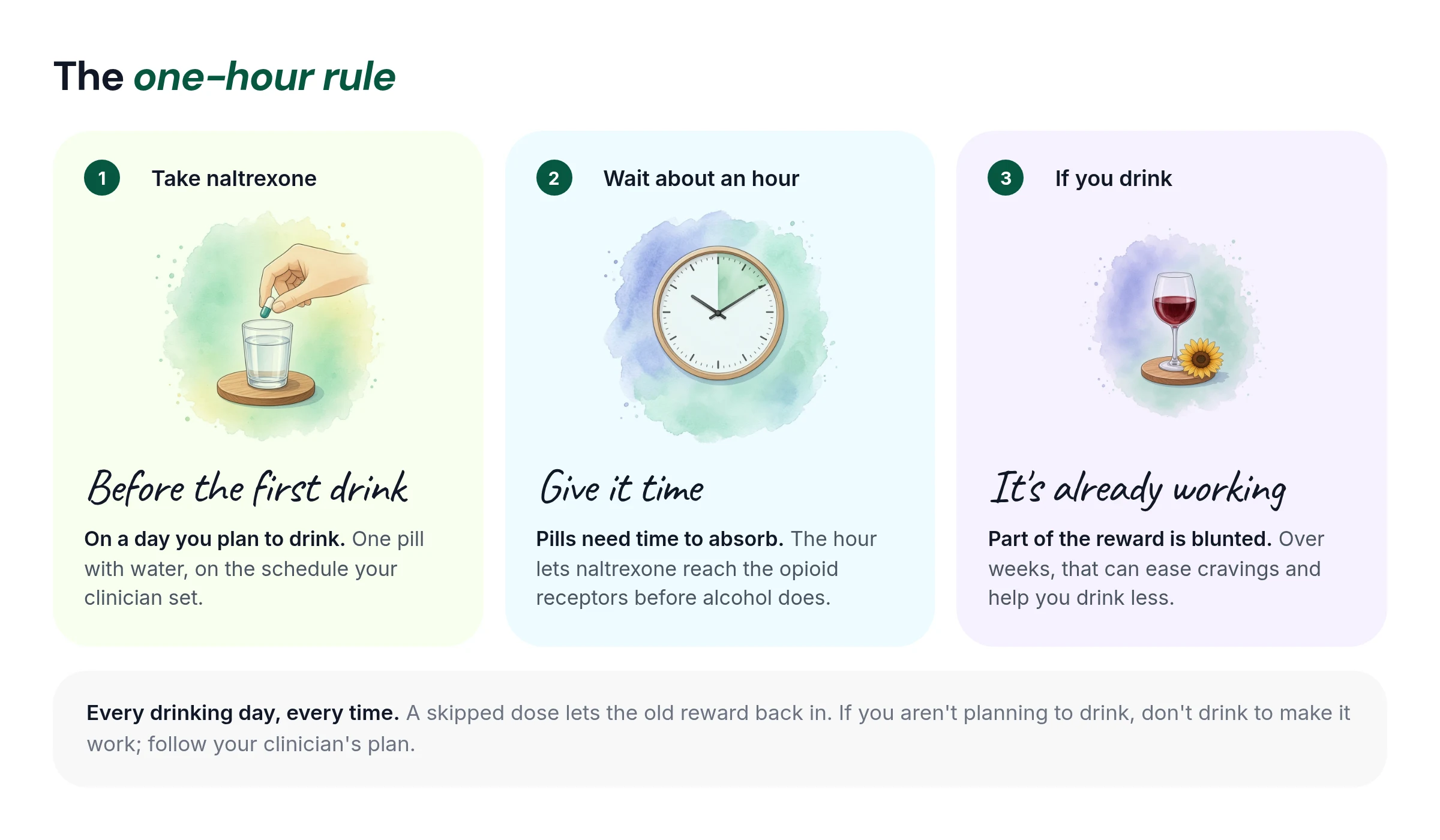
Oral naltrexone is absorbed rapidly, with peak blood levels occurring within about an hour. Sinclair-style protocols therefore commonly time the medication before anticipated drinking, although targeted clinical trials have used somewhat different timing, including 1 to 2 hours before high-risk situations. Naltrexone blocks opioid receptors involved in alcohol-related reward; the exact mechanism responsible for its benefit in alcohol use disorder remains incompletely understood.
If you already take naltrexone daily for alcohol cravings, this is a different schedule rather than a different drug, and an appropriately licensed clinician may prescribe naltrexone when it is clinically appropriate and permitted under applicable state law, though taking it only before drinking is off-label. You can read how people handle a craving in the moment while the method does its slower work, and the how to get naltrexone online guide walks through the visit. Our naltrexone program sets up the prescription and the check-ins.
Why drinking and medication are paired in the Sinclair model#
The Sinclair Method pairs naltrexone with the drinking you have planned, to blunt alcohol's pull and, over time, your cravings. This approach is based on a proposed learning process sometimes called pharmacological extinction (Sinclair 2001). It is a theory of how the method may work, not a proven sequence that happens the same way in everyone.
No one should start or continue drinking solely to make naltrexone "work." If you are not planning to drink, do not drink for the purpose of creating an "extinction" session; follow the dosing plan prescribed by your clinician.
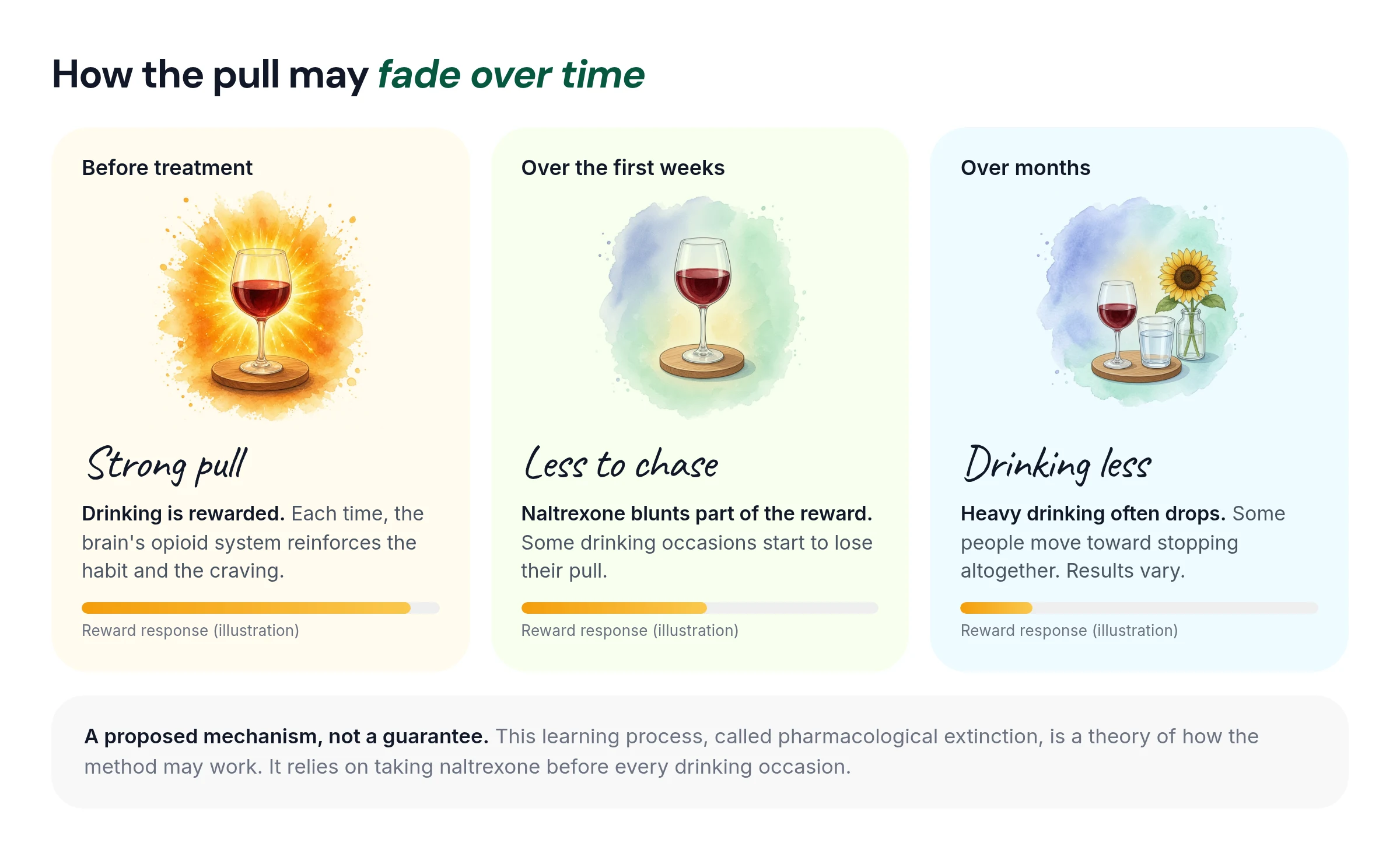
This runs against the abstain-first model most people picture. The aim is usually to drink less first, though some people eventually stop drinking altogether and reach complete abstinence. For the background on where naltrexone acame from, and the evidence behind it, the history and evidence guide goes deeper, and the cost and insurance breakdown covers what it runs. You can get naltrexone from us at Sunflower without quitting beforehand.
Where the 78 percent number really comes from#
You may see claims that the Sinclair Method has a "78% success rate", that number comes from an uncontrolled report on patients at Sinclair's own clinics in Finland, discussed in his 2001 review. Of 147 patients with enough treatment to be classified, 115 were called "successful" by the clinic's own criteria (Sinclair 2001). This uncontrolled clinic figure should not be interpreted as a validated 78% probability that the Sinclair Method will work for an individual patient.
Randomized trials support naltrexone, including some targeted-use strategies, but results vary by population, outcome, adherence, and accompanying behavioral treatment. In a 2023 systematic review of 118 trials, oral naltrexone 50 mg a day had a number needed to treat of about 11 to prevent one return to heavy drinking compared with placebo, and about 18 to prevent one return to any drinking; most of those studies also included counseling or another nonmedication intervention (McPheeters 2023).
The targeted-naltrexone evidence is real but narrower. In a 2009 randomized trial of 163 problem drinkers, naltrexone taken 1 to 2 hours before anticipated high-risk drinking situations improved some drinking outcomes, particularly among men, and the investigators concluded that more effective strategies were still needed (Kranzler 2009).
A more recent 2022 randomized trial studied targeted 50-mg naltrexone in 120 sexual and gender minority men who binge drank and had mild-to-moderate alcohol use disorder.
With weekly counseling, targeted naltrexone reduced several binge-drinking and alcohol-consumption outcomes compared with placebo (Santos 2022). Because the study involved a specific population and relatively small sample, it supports targeted dosing but does not establish that the full Sinclair protocol works equally well across all patients with alcohol use disorder.
That 2009 trial excluded people with clinically severe alcohol dependence and several other conditions. The Finnish trial often cited for the method treated people without prior detoxification, but it combined the medication with behavioral treatment and began with 12 weeks of daily dosing before the targeted phase (Heinälä 2001).
One honest note on labels: Naltrexone is FDA-approved for alcohol use disorder, but the before-you-drink protocol is a way of using the drug, not a separately approved product. A clinican can still prescribe it this way, and here at Sunfloer we build the program and follow-up around that use.
The evidence is still mostly from smaller targeted-dosing trials of naltrexone, with no large trial of the full Sinclair protocol, and some clinicians argue it oversimplifies alcohol use disorder as a behavior problem.
What the first weeks actually feel like#
Some people notice little or no obvious subjective effect from the first dose. Others may notice side effects such as nausea, headache, fatigue, dizziness, or changes in how rewarding alcohol feels. Not noticing an immediate effect does not by itself determine whether treatment will ultimately be helpful.
Treatment response varies. Changes in heavy drinking or craving may emerge over the first several weeks, but some patients obtain little benefit and the medication should not simply be continued indefinitely without reassessment.
Your clinician should review response, side effects, adherence, and treatment goals and adjust the plan when needed. Naltrexone has been FDA-approved for alcohol use disorder since 1994, and the evidence points to fewer heavy drinking days as the main payoff.
Common side effects and important safety risks#
At standard doses, naltrexone is generally well tolerated, but liver enzyme elevations and clinically significant liver injury have been reported. Your clinician should review your liver history and other relevant medications and determine whether laboratory monitoring is appropriate, according to the prescribing information.
Naltrexone blocks opioids, including opioid pain medicines. See the opioid note above before starting. This is especially important if you need them for surgery, or an injury, and your clinician has to know you are taking it. The label also notes depression, and rarely, thoughts of self-harm, at rates close to placebo and with no proven causal link.
Report new or worsening depression or other significant mood changes to your clinician. If you develop suicidal thoughts, feel unable to keep yourself safe, or are in a mental health crisis, call or text 988; call 911 for immediate danger.
Nausea is also the most common side effect; the current label reports new-onset nausea in approximately 10% of people in an open-label alcohol-dependence safety study, which is not a placebo-controlled incidence estimate.
Nausea usually shows up early and often eases as your body adjusts, and taking the dose with food can help. If it doesn't ease, talk to your prescriber. Headache, tiredness, and trouble sleeping turn up for some people, and they are often mild and may ease with time; tell your prescriber if they persist.
When it stalls, or does not work at all#
One possible reason the method falls short is skipped doses, because consistent adherence to the prescribed schedule may improve treatment effectiveness, though modest overall effects of naltrexone may also play a part. Some trials of targeted dosing show reduced drinking, though the evidence is limited and mixed.
The method asks for the medication before every drinking session, and that consistency is the hard part for most people. There is no controlled evidence establishing that one drinking episode without naltrexone actively reverses prior therapeutic gains.
It is also not the right tool for everybody: if your body is physically dependent on alcohol, cutting back or stopping can set off dangerous withdrawal, so that needs medical supervision, not quitting cold turkey on your own.
If you develop shaking, sweating, marked anxiety, vomiting, or a rapid heartbeat after reducing alcohol, seek same-day medical assessment because alcohol withdrawal can worsen rapidly.
Confusion, hallucinations, seizures, severe agitation, loss of consciousness, or other severe symptoms require emergency care; call 911. People with a history of withdrawal seizures or delirium tremens should discuss withdrawal management with a clinician before substantially reducing or stopping alcohol. If you are in a mental health crisis, call or text 988.
Some people take naltrexone faithfully and still feel little, that happens and it's why a clinician follows up instead of handing over a prescription and dissapearing. And if drinking sits inside a wider pattern of substance use disorders, medication alone may not reach what is driving it, and that is when a clinician trained in addiction medicine, and a fuller treatment plan, matter.
How to start without quitting first#
Naltrexone can be started while a person is still drinking; abstinence is not required before treatment.
Treatment begins with a clinical evaluation, which may be performed by telehealth when clinically appropriate and legally permitted.
The clinician should assess alcohol use and withdrawal risk, recent opioid exposure, medications and other substance use, relevant medical and psychiatric conditions, and liver or kidney concerns before deciding whether naltrexone, and whether daily or targeted dosing, is appropriate. Follow-up is important to assess response, adherence, adverse effects, and treatment goals.
If a targeted schedule is prescribed, take naltrexone as directed before anticipated drinking. Treatment response varies and should be reassessed with your clinician rather than continued indefinitely without follow-up.
If you are interested in naltrexone, a licensed clinician can review your medical history and other safety factors to determine whether treatment, and whether a targeted Sinclair-style schedule, is appropriate for you.
Questions People Ask Before Trying TSM#
Is the Sinclair Method the same as just taking naltrexone?#
It uses the same medication, but on a targeted, off-label schedule rather than the FDA-labeled once-daily schedule. Sinclair-style protocols commonly time the dose before anticipated drinking, often about an hour beforehand, though clinical trials have used timing of 1 to 2 hours. A reduction goal is appropriate for some patients, whereas abstinence may be safer or preferred for others.
Do I really have to keep drinking?#
No one should start or continue drinking solely to make naltrexone "work." In the Sinclair model, naltrexone is taken before anticipated drinking rather than requiring abstinence first. If you are not planning to drink, do not drink for the purpose of creating an "extinction" session; follow the dosing plan prescribed by your clinician.
The Sinclair model emphasizes taking naltrexone before a drinking ocassion. Daily naltrexone is another established approach and is the FDA-labeled oral regimen, so patients should follow the schedule prescribed for them rather than changing dosing on their own. Over time some people cut back and some move toward abstinence.
Can I stop the pill once I am drinking less?#
The appropriate duration of naltrexone varies. Do not stop it or change from daily to targeted dosing without discussing the plan with your clinician; treatment duration should be based on your response, drinking goals, relapse risk, side effects, and preferences.
Is naltrexone safe for my liver?#
At standard doses, naltrexone is generally well tolerated, but liver enzyme elevations and clinically significant liver injury have been reported. Your clinician should review your liver history and other relevant medications and determine whether laboratory monitoring is appropriate, which is part of why this runs through a medical visit.
References#
- Naltrexone hydrochloride tablet, film coated [prescribing information]. DailyMed, US National Library of Medicine. Available at: dailymed.nlm.nih.gov. Accessed November 10, 2026.
- Substance Abuse and Mental Health Services Administration. Medication for the Treatment of Alcohol Use Disorder: A Brief Guide. HHS Publication No. (SMA) 15-4907. SAMHSA and NIAAA; 2015. Available at: store.samhsa.gov. Accessed November 10, 2026.
- McPheeters M, O'Connor EA, Riley S, et al. Pharmacotherapy for alcohol use disorder: a systematic review and meta-analysis. JAMA. 2023;330(17):1653-1665. doi:10.1001/jama.2023.19761
- Jonas DE, Amick HR, Feltner C, et al. Pharmacotherapy for adults with alcohol use disorders in outpatient settings: a systematic review and meta-analysis. JAMA. 2014;311(18):1889-1900. doi:10.1001/jama.2014.3628
- Sinclair JD. Evidence about the use of naltrexone and for different ways of using it in the treatment of alcoholism. Alcohol Alcohol. 2001;36(1):2-10. doi:10.1093/alcalc/36.1.2
- Anton RF, O'Malley SS, Ciraulo DA, et al. Combined pharmacotherapies and behavioral interventions for alcohol dependence: the COMBINE study: a randomized controlled trial. JAMA. 2006;295(17):2003-2017. doi:10.1001/jama.295.17.2003
- Volpicelli JR, Alterman AI, Hayashida M, O'Brien CP. Naltrexone in the treatment of alcohol dependence. Arch Gen Psychiatry. 1992;49(11):876-880. doi:10.1001/archpsyc.1992.01820110040006
- Heinälä P, Alho H, Kiianmaa K, Lönnqvist J, Kuoppasalmi K, Sinclair JD. Targeted use of naltrexone without prior detoxification in the treatment of alcohol dependence: a factorial double-blind, placebo-controlled trial. J Clin Psychopharmacol. 2001;21(3):287-292. doi:10.1097/00004714-200106000-00006
- Kranzler HR, Tennen H, Armeli S, et al. Targeted naltrexone for problem drinkers. J Clin Psychopharmacol. 2009;29(4):350-357. doi:10.1097/JCP.0b013e3181ac5213
- Santos GM, Ikeda J, Coffin P, et al. Targeted oral naltrexone for mild to moderate alcohol use disorder among sexual and gender minority men: a randomized trial. Am J Psychiatry. 2022;179(12):915-926. doi:10.1176/appi.ajp.20220335
- Harvard Health Publishing. Can you retrain your brain to stop excessive drinking? Harvard Medical School. Available at: harvardhealth.org. Accessed November 10, 2026.