

The same medication can cost you about $35 to $40 a month as a generic tablet with a discount coupon, or roughly $1,500 to $1,800 or more a month as the Vivitrol injection, before insurance, though the price varies by pharmacy and clinic.
Both formulations contain naltrexone and are used for alcohol use disorder. Oral naltrexone is FDA-approved for alcohol dependence and blockade of the effects of exogenous opioids; extended-release injectable naltrexone is FDA-approved for alcohol dependence and for prevention of relapse to opioid dependence following opioid detoxification.
That's the thing nobody tells you up front. "How much does naltrexone cost" doesn't have one answer, it has about five, and the cheap one and the expensive one are both real.
So here's the honest breakdown: what each version costs, what insurance actually covers, and what you're really paying for when a program bundles it into a monthly fee.
What it actually costs#
For the daily pill, a commonly used formulation, naltrexone is cheap. Generic tablets often list at $85 or more a month at full retail price, but cash prices with a pharmacy coupon are usually about $32 to $40.
With insurance, generic oral naltrexone is covered by many insurance plans, but copays, deductibles, formulary placement, and prior-authorization requirements vary by plan.
The once-a-month injection, Vivitrol, is the outlier. It runs over $1,000 a month without insurance.
Everything else, the doctor visit, compounded formulas, telehealth programs, sits between those two poles. The rest is just sorting out where your money actually goes.
Generic tablets: the cheapest path, and its catch#
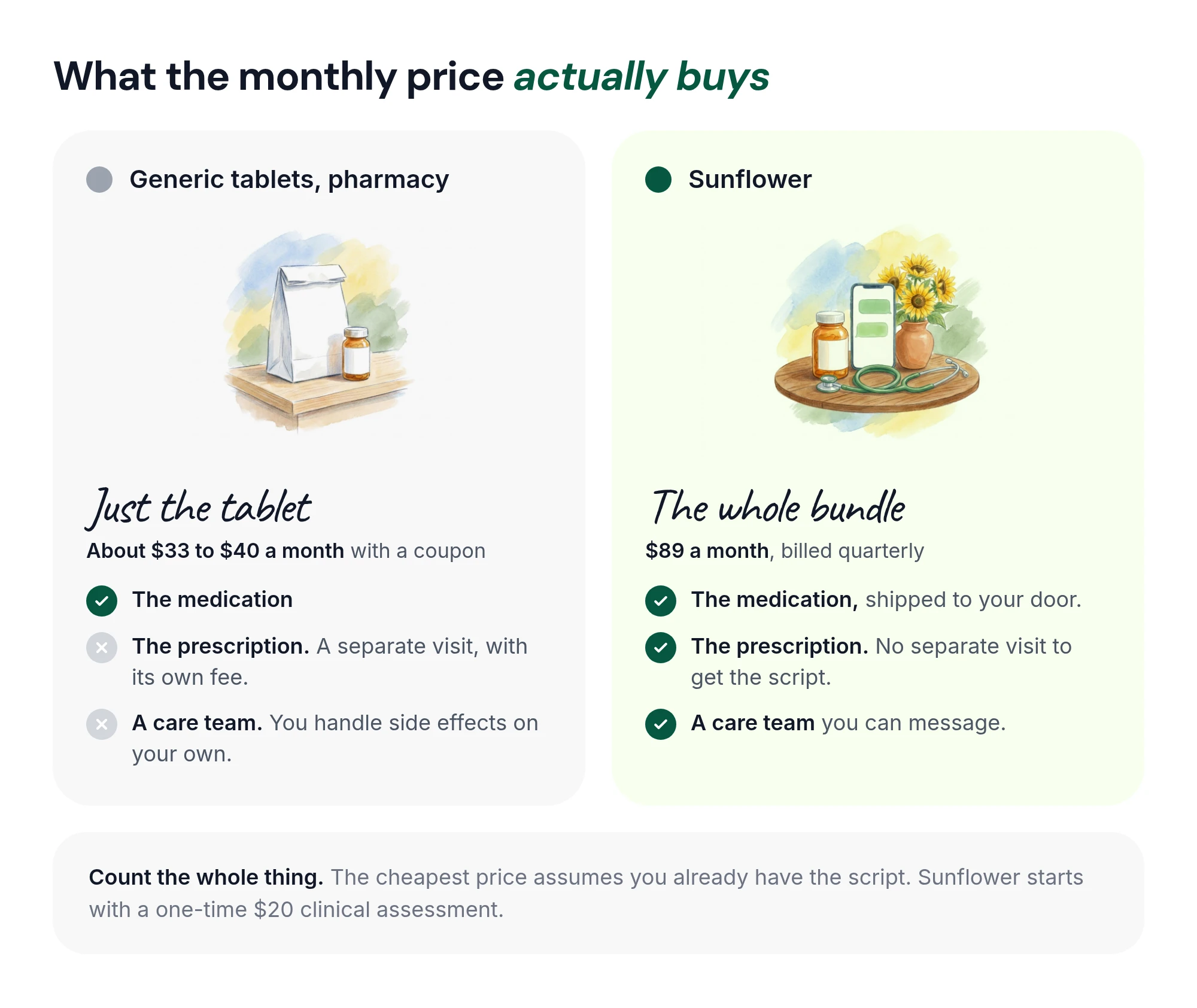
Naltrexone was first approved by the FDA in 1984, and generic tablets have been available since about 2000, so the pill itself is cheap to make. At many US pharmacies the cash price for 30 tablets of the 50mg generic runs roughly $45 to $90 without a discount card, though some charge more and a few charge less, depending on the pharmacy. Pull a free coupon from GoodRx or a similar card and that drops to roughly $33 to $40 for the month.
No insurance, no subscription, no catch on the drug itself: walk in with a prescription, walk out for less than a tank of gas.
So why doesn't everyone just do that? Two reasons.
First, you still need the prescription: Naltrexone isn't a controlled substance, but it's not over the counter either, someone has to evaluate you and write the script, and that visit has its own cost (more on that below).
Second, the pharmacy price generally covers the medication only; clinical visits, follow-up, and messaging support may be billed separately depending on the prescriber.
For some people that's fine, for a lot of people, the drug is the easy part, and the support is what makes it stick, the kind that helps you ride out a craving instead of facing it alone. That's the real trade-off in pricing, and it's worth naming before you shop on sticker price alone.
If you want the full picture of how the medication works and who it's for, the naltrexone for alcohol guide covers it.
With insurance: often near-free, with strings#
Here's some good news that doesn't get said enough: under the Affordable Care Act, substance use disorder treatment is an essential health benefit, which means every Marketplace plan has to cover it, and plans can't slap a yearly or lifetime dollar cap on it. Most insurance plans, including Marketplace plans, can't put stricter limits or higher costs on alcohol use disorder treatment than on regular medical care.
In practice, generic oral naltrexone is usually covered by insurance and often needs little or no prior authorization, though coverage and rules still vary by plan. It's rarely left off insurer drug lists, and it usually sits on a low copay tier. A lot of people pay $0 to $15 a month.
On price, insurance usually comes out ahead, the cost shows up as friction instead.
Most plans don't require prior authorization for generic oral naltrexone, though some do. The injection (Vivitrol) often does, but it varies by plan, so check your plan's formulary. If your plan asks for it, your prescriber may need to document an alcohol or opioid use disorder diagnosis.
Using insurance generally creates a claim record with the health plan, which may matter to patients who prefer to pay privately. Health information remains subject to applicable privacy protections.
None of that is a dealbreaker, it's just the quiet cost of the cheap route: a little paperwork, a little less privacy, sometimes a wait. For most people that's a fine trade, some would rather skip it.
Vivitrol: the expensive end, and when it earns it#
Vivitrol is naltrexone too. Same drug, just delivered as a 380-mg extended-release injection administered by a healthcare professional every four weeks or once monthly, instead of a daily pill.
And it costs a fortune by comparison: without insurance, a single monthly injection commonly runs over $1,000 (and can top $1,700 at some pharmacies!). That's for one shot, one month.
Why the gap? Vivitrol is the brand-name extended-release naltrexone injection. FDA-approved generic extended-release naltrexone products now exist, although availability and pricing may vary by pharmacy and health system.
Is it ever worth it? Sometimes, yes, because it does not require daily dosing, extended-release naltrexone can be useful for patients who have difficulty taking a tablet consistently, although monthly injection appointments still need to be maintained.
Eligible patients may qualify for the manufacturer's copay program, subject to program limits. The program currently provides up to $500 per prescription toward the medication cost and does not cover office-visit or medication-administration charges. It is not available to patients whose medication costs are paid in whole or in part by specified government health programs.
However, if you're comparing cash prices and a daily tablet works for you, oral naltrexone uses the same medicine at a tiny fraction of the cost, though it works best when you take it consistently, and many people find daily dosing hard to keep up.
For many patients, oral naltrexone is a reasonable option because it is inexpensive and has strong evidence for AUD. Extended-release naltrexone may be preferable for some patients, including those for whom daily adherence is difficult. The choice should be individualized with a clinician.
Naltrexone is not appropriate for everyone. It can precipitate withdrawal in someone who is physically dependent on opioids and blocks the effects of opioid pain medicines. Before prescribing it, a clinician should review current and recent opioid use, other medications, relevant medical history, and liver-related concerns. Extended-release injectable naltrexone requires an adequate opioid-free period before treatment.
Compounded naltrexone and telehealth pricing#
There's a third version you'll run into with online programs: compounded naltrexone, where a pharmacy mixes naltrexone with another ingredient, sometimes vitamin B6, into a single made-to-order tablet.
Sunflower uses a compounded tablet containing naltrexone 45 mg plus vitamin B6 5 mg. Naltrexone is an FDA-approved active ingredient, but this compounded combination product itself is not FDA-approved and has not undergone FDA premarket review for safety, effectiveness, or quality.
Compounding allows a pharmacy to prepare a patient-specific formulation when the prescribing clinician determines that the available FDA-approved product does not appropriately meet that patient's medical needs. Compounded drugs are not FDA-approved finished products.
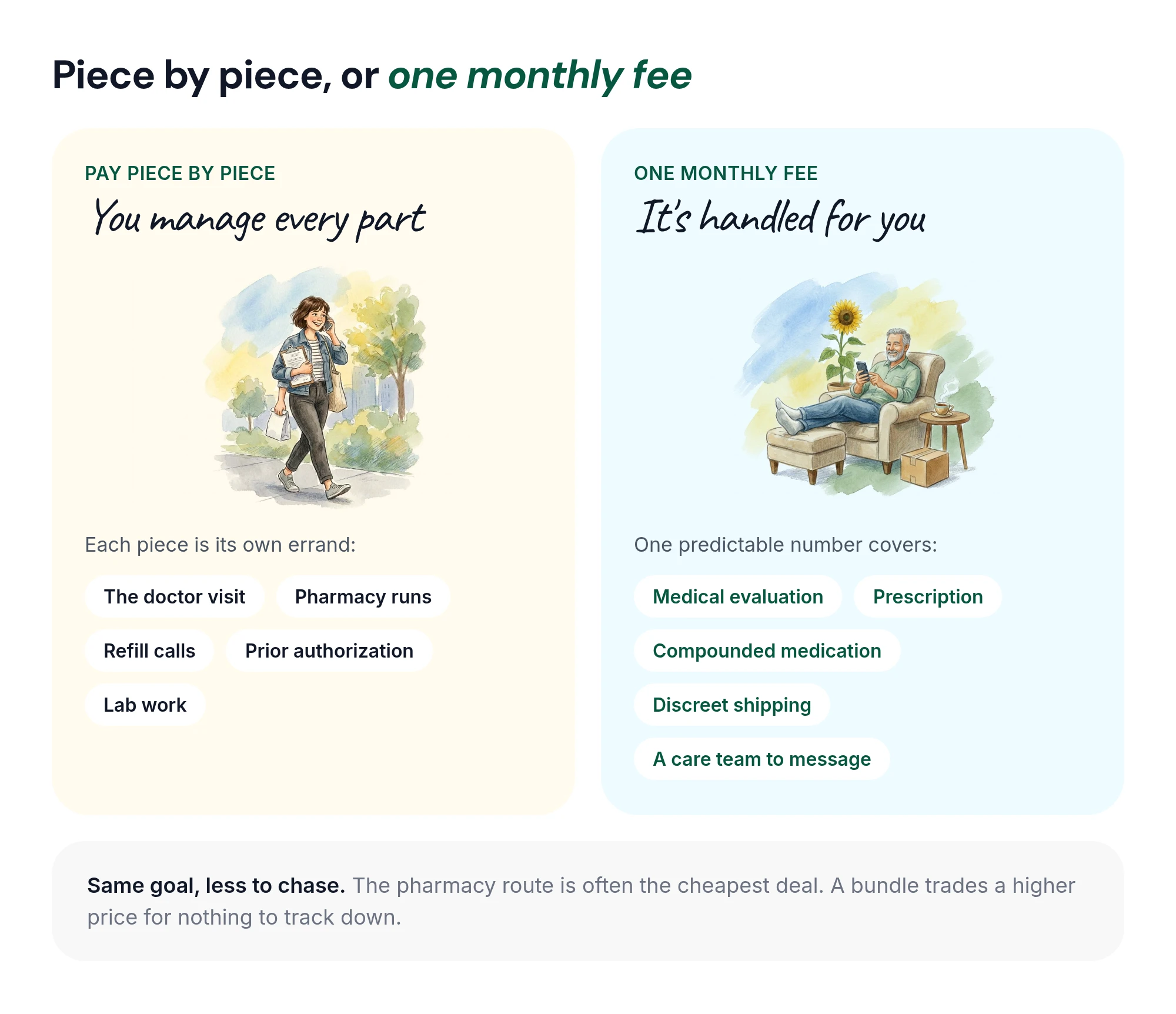
When you see a flat monthly price from a telehealth program, you're not just paying for pills. You're paying for the whole bundle: the medical evaluation, the prescription, the compounded medication, discreet shipping to your door, and a care team you can message. Priced separately, those add up, bundled, they're meant to be one predictable number with nothing to chase down.
The costs people forget to count#
The pill price is the number everyone quotes, it's not the number you actually pay. Let's now review a few costs nobody warns you about
The prescription itself: someone has to evaluate you first. That's a doctor visit, a telehealth intake, or an urgent care stop, and it has a fee whether or not insurance covers part of it. The cheap GoodRx price assumes you already have the script in hand.
Refills: Oral naltrexone is taken daily while it is being prescribed; treatment duration varies according to response, goals, tolerability, and clinical follow-up. Whatever your monthly number is, multiply it out. A $40 month is about $480 a year. A program at $89 a month is a little over $1,000 a year: both are real, and both are what you should be comparing, not the first month alone.
Lab work: The liver processes naltrexone, so a prescriber may want baseline bloodwork before you start or check in along the way: usually minor, sometimes a separate line item.
Your time: Pharmacy runs, refill calls, chasing a prior authorization. Not dollars exactly, but it's the reason some people happily pay more for something that just shows up at the door.
None of this makes the pharmacy route a bad deal, it's often the best deal, just count the whole thing, not the headline.
Is it worth the money?#
Quick gut check before you decide any of this is too expensive: what does the drinking cost?
Two bottles of wine a week, or a few rounds out, runs most people more per month than a generic naltrexone script. Alcohol can also carry health and indirect costs that do not appear on a receipt; sustained or heavy drinking increases the risk of sleep disruption, liver disease, and other medical problems.
Does the medication earn its keep? The evidence says yes. Clinical trials support oral naltrexone, particularly the studied 50-mg/day regimen, for reducing return to heavy drinking in adults with AUD. A 2023 systematic review estimated that about 11 people would need to be treated with oral naltrexone 50 mg/day to prevent one additional return to heavy drinking compared with placebo. These studies did not specifically evaluate Sunflower's compounded 45-mg naltrexone plus 5-mg B6 formulation.
In plain numbers, treating about eleven people keeps one more of them from sliding back into heavy drinking who otherwise would have. For a cheap, non-addictive daily pill with decades of trials behind it, that's real value. The FDA label puts it plainly too: it's a tool that works alongside the rest of your plan, not a cure on its own.
Where it really pays off is with support around it: someone to set the dose, check in, and get you through the first rough weeks. That's the piece a bare prescription skips and a program like Sunflower builds in.
How the Sunflower price works#
If the bundled route is what you want, here's exactly what it costs.
It starts with a $20 clinical assessment: you complete an online clinical assessment that is reviewed by a licensed clinician. The clinician determines whether the available information is sufficient and whether naltrexone is medically appropriate; some patients may need additional evaluation or may not be eligible for treatment through the online pathway.Twenty dollars, one time, whether or not you're approved.
If you are approved, the medication is $89 a month, billed quarterly, with a three-month supply shipped to your door. That one number covers the compounded naltrexone, the shipping, and a care team you can message with questions or side effects. No long-term contract, cancel anytime.
At a little over $1,000 a year all in, it's more than a bare GoodRx script and far less than Vivitrol. What you're buying is the no-chasing version: no pharmacy line, no separate outside prescriber appointment or retail-pharmacy pickup.
If that's the trade you want, you can see if you qualify in about five minutes. If the cheaper DIY route fits you better, now you know what each piece actually costs, which was the point.
This article provides general educational information and is not a substitute for individualized medical advice. Naltrexone requires a prescription, and whether it is appropriate depends on an individual's medications, opioid exposure, medical history, and other clinical factors.
Naltrexone cost FAQs#
What's the cheapest way to get naltrexone?#
Generic 50mg tablets with a pharmacy discount card, often around $33 to $40 a month cash. You still need a prescription first, so factor in the cost of the visit to get one.
Is naltrexone covered by insurance?#
Usually, yes. Substance use disorder treatment is a required benefit on ACA Marketplace plans, and generic oral naltrexone is rarely excluded and typically lands on a low copay tier. Many people pay $0 to $15 a month, sometimes after a prior authorization.
How much is naltrexone without insurance?#
For the generic pill, roughly $35 to $70 a month cash, less with a coupon. For the Vivitrol injection, over $1,000 a month. Telehealth programs that bundle everything tend to land somewhere in the middle.
Why is compounded naltrexone priced differently than the generic?#
A compounded version is made to order by a licensed pharmacy, often combined with another ingredient like B6, and sold through a telehealth program rather than a retail pharmacy. The price reflects the whole service, evaluation, medication, shipping, and support, not just the tablet.
Why does Vivitrol cost so much more?#
Vivitrol is the brand-name extended-release naltrexone injection. FDA-approved generic extended-release naltrexone products now exist, although availability and pricing may vary by pharmacy and health system.”Can I cancel a monthly program?
With Sunflower, yes. The $89/month plan has no long-term contract and you can cancel anytime. Terms vary by provider, so check before you sign up anywhere.
References#
- Naltrexone Hydrochloride Tablets, USP [prescribing information]. DailyMed, US National Library of Medicine. Updated February 5, 2026. Accessed October 29, 2026. https://dailymed.nlm.nih.gov/dailymed/drugInfo.cfm?setid=21b43dab-015c-c82f-ba6e-27da0ec12fc5
- Center for Substance Abuse Treatment. Incorporating Alcohol Pharmacotherapies Into Medical Practice. Treatment Improvement Protocol (TIP) Series 49. Substance Abuse and Mental Health Services Administration (SAMHSA). Accessed October 29, 2026. https://www.ncbi.nlm.nih.gov/books/NBK64042/
- Jonas DE, Amick HR, Feltner C, et al. Pharmacotherapy for adults with alcohol use disorders in outpatient settings: a systematic review and meta-analysis. JAMA. 2014;311(18):1889-1900. doi:10.1001/jama.2014.3628
- HealthCare.gov. Mental health & substance abuse coverage. US Centers for Medicare & Medicaid Services. Accessed October 29, 2026. https://www.healthcare.gov/coverage/mental-health-substance-abuse-coverage/
- GoodRx. Naltrexone prices, coupons & savings tips. Accessed October 29, 2026. https://www.goodrx.com/naltrexone
- Vivitrol (naltrexone extended-release injectable). Drugs.com Price Guide. Accessed October 30, 2026. https://www.drugs.com/price-guide/vivitrol