
The standard oral dose of naltrexone for alcohol use disorder is 50 mg once a day. That is the dose on the FDA label, in current guidelines, and in most of the trials. Some clinicians use 50 mg on a targeted, as-needed basis around periods of higher drinking risk, but that approach is off-label and less extensively studied.
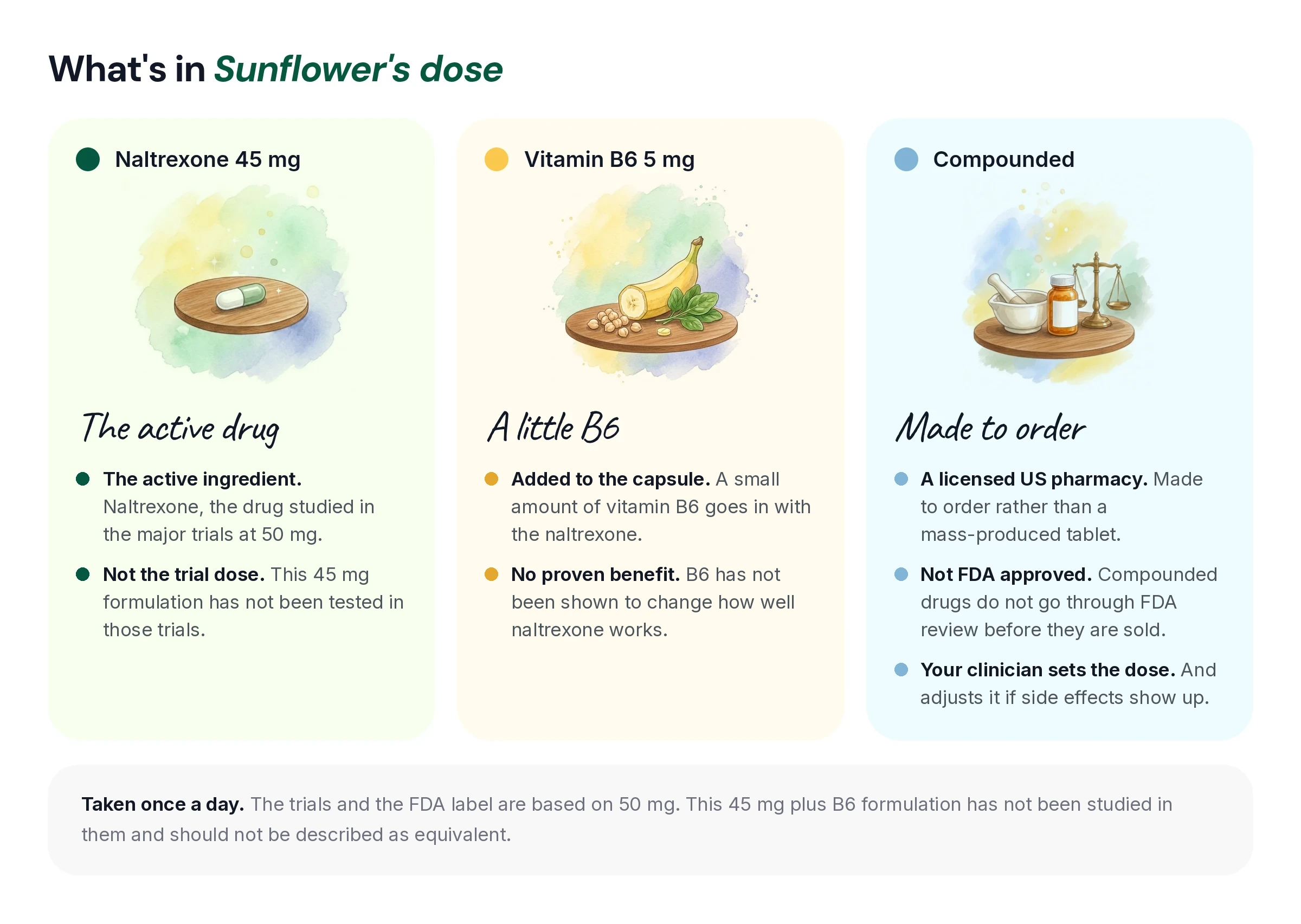
Sunflower uses a compounded formulation containing 45 mg of naltrexone plus 5 mg of vitamin B6, made by a licensed US pharmacy and taken once a day.
Although 45 mg is close to the standard 50 mg dose, this exact compounded formulation has not been studied in the clinical trials that established the effectiveness of 50 mg naltrexone, and it should not be described as therapeutically equivalent.
How much naltrexone do you take for alcohol?#
The standard oral naltrexone dose studied most extensively for alcohol use disorder is 50 mg once daily, taken with or without food, whether or not you plan to drink that day. For daily treatment, naltrexone is generally taken once each day at a consistent time. The timing can be individualized with your prescriber, for example around the time of day your cravings tend to show up.
Your dose and timing should follow your prescription. A clinician settles that with you, which is how Sunflower's naltrexone program handles it when you sign up.
If you are still weighing whether the medication is right for you, start with how naltrexone works for alcohol. This page is only about the dose.
Does naltrexone actually work for alcohol?#
Oral naltrexone is one of the best-studied medications for alcohol use disorder.
In a 2023 systematic review and meta-analysis in JAMA, oral naltrexone 50 mg a day reduced return to heavy drinking compared with placebo, with a number needed to treat of 11. That means that, across the included trials, about 11 people would need to be treated for one additional person to avoid returning to heavy drinking. An earlier JAMA review put that figure at 12.
Naltrexone is thought to take some of the edge off alcohol's reward, so drinking may pull at you less. Most clinical trials evaluated naltrexone alongside counseling, medical management, or another psychosocial intervention. For the fuller picture, see the history and evidence behind naltrexone.
About Sunflower's 45 mg naltrexone plus B6 formulation#
Your bottle from Sunflower reads naltrexone 45 mg with 5 mg of vitamin B6. This is a program-specific compounded formulation, made to order by a licensed US pharmacy rather than a mass-produced tablet. The FDA labeling for oral naltrexone in alcohol use disorder recommends 50 mg once daily, and most major clinical trials used that dose, though a few, such as COMBINE, tested 100 mg.
Compounded drugs are not FDA-approved and do not go through FDA review for safety, effectiveness, or quality before they are sold. This exact 45 mg plus B6 formulation has not been tested in the trials described above, so the results of those trials cannot be assumed to apply to it in the same way.
The vitamin B6 has not been shown to change how well naltrexone works or how well it is tolerated.
Because it is compounded rather than a stock product, you pay for it directly instead of through insurance, which is what the program's pricing covers. Your clinician sets the final dose, and Sunflower's clinical safety standards cover how that is handled.
Daily dose, or a dose before you drink?#
There are two ways people take naltrexone for alcohol, built around different goals.
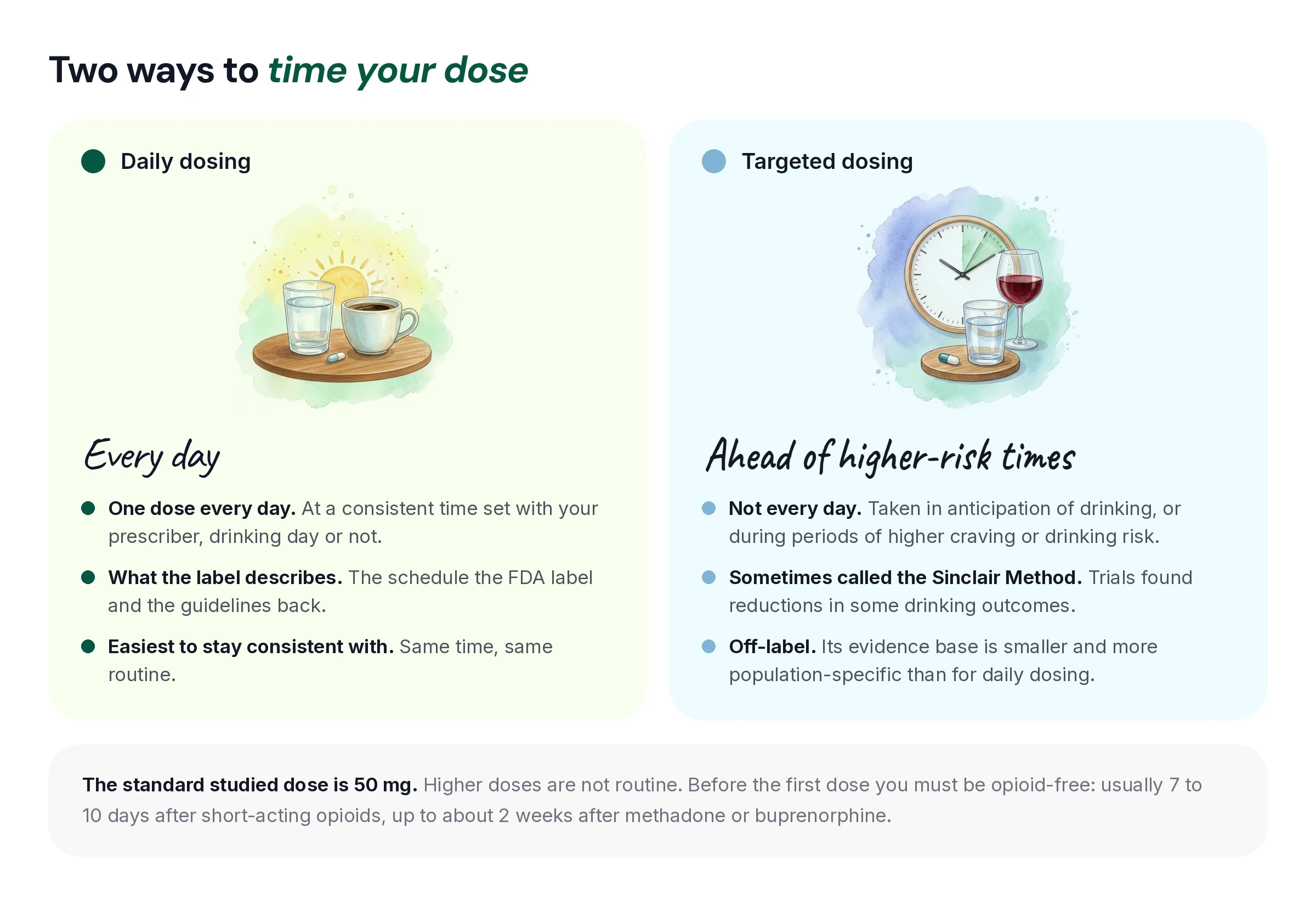
The first is daily, the way the FDA label describes. You take one dose each day at a consistent time, drinking day or not. This is the schedule the guidelines back, and it is the easiest to stay consistent with. Naltrexone may be prescribed through telemedicine when a clinician determines that remote evaluation is clinically appropriate and you meet the safety and eligibility requirements. Our guide covers how to get naltrexone online.
The second is targeted, sometimes called the Sinclair Method. Targeted naltrexone is an off-label approach in which naltrexone is taken in anticipation of drinking, or during periods of higher craving or drinking risk, rather than every day.
Randomized trials have found reductions in some drinking outcomes with targeted 50 mg dosing, including a 2022 trial in sexual and gender minority men with mild to moderate alcohol use disorder who also received counseling. The evidence base is smaller and more population-specific than the evidence for 50 mg daily dosing.
In one Finnish trial, participants received 50 mg daily for 12 weeks and then took the medication only when craving alcohol for another 20 weeks. Among participants receiving coping-skills therapy, 27% of those assigned naltrexone had no relapse to heavy drinking over 32 weeks, compared with 3% of those on placebo.
One thing to be straight about: targeted use is off-label. The FDA approval and the label are written for daily dosing. The often-repeated 78% success figure for the Sinclair Method traces back to its own advocates rather than a controlled trial, so treat it with more caution than the trial results above. Which schedule fits you is a decision to make with your prescriber.
Medication works on the chemistry. The habits and triggers around drinking are a separate piece of the work. That is why learning to manage a craving in real time and understanding why you miss the state and not the substance still matter. Sunflower pairs the prescription with therapy and ongoing support for that reason.
Starting out, and how to not feel sick the first week#
Nausea is one of the most common side effects of naltrexone and may improve as treatment continues. If side effects are difficult to tolerate, clinicians sometimes use a temporary 25 mg dose before increasing to the usual 50 mg dose. Taking the medication with food may also help some people.
Headache, dizziness, and trouble sleeping turn up for some people too. If the side effects are rough, the move is to ask your prescriber about easing in more slowly, not to push through or stop on your own.
How high can the dose go, and what about your liver?#
For alcohol use disorder, 50 mg once daily is the standard oral dose and has the strongest evidence base. Higher doses, including 100 mg daily, have been studied and may occasionally be considered by a clinician, but higher dosing is not routine and requires individualized assessment because adverse-effect and liver-related risks may increase.
Naltrexone previously carried a boxed warning about hepatotoxicity, which the FDA removed in 2013. Current prescribing information still includes a liver-injury warning. Clinicians consider baseline liver disease and liver-test abnormalities when deciding whether naltrexone is appropriate and whether additional monitoring is needed.
If you forget a dose, take it as soon as you remember. If it's almost time for the next one, skip the missed dose and take the next as scheduled. Never double up to make up for a missed dose.
Before your first dose: the opioid-free window#
This is the one rule you cannot skip. Before starting naltrexone, you must be adequately opioid-free. For people previously using short-acting opioids, the usual minimum interval is 7 to 10 days.
People transitioning from methadone or buprenorphine may remain at risk for precipitated withdrawal for up to about 2 weeks and need an individualized assessment by a clinician. This includes prescription opioids and tramadol as well as illicit opioids.
Naltrexone blocks opioid receptors, and starting it too soon can set off sudden, severe withdrawal that can be serious enough to need hospital care. Tell your prescriber about opioid-containing pain, cough, or diarrhea medicines and any recent methadone or buprenorphine use.
Trying to overcome naltrexone's opioid blockade by taking large amounts of opioids can cause a fatal overdose. People who previously used opioids may also become more sensitive to opioids after naltrexone is stopped or its blocking effect wears off, so doses that were previously tolerated may cause an overdose.
If you or someone near you shows signs of an overdose or a severe reaction, call 911. If you are in crisis or thinking about harming yourself, call or text 988 for the Suicide and Crisis Lifeline.
The simplest way to get the dose right#
For most people, it comes down to this: take the dose you are prescribed, consistently, with a clinician adjusting if side effects show up. The standard studied dose is 50 mg a day; Sunflower's compounded version contains 45 mg of naltrexone plus 5 mg of vitamin B6 and has not itself been tested in those trials. If you want that handled start to finish, from the assessment to the prescription to the check-ins, start with Sunflower's naltrexone program.
Naltrexone Dosing Questions People Ask#
Is 45 mg of naltrexone as effective as 50 mg?#
That has not been shown. The trials and the FDA label are based on 50 mg, so that is where the evidence sits. Sunflower's compounded formulation contains 45 mg of naltrexone plus 5 mg of vitamin B6.
Although 45 mg is close to 50 mg, this exact formulation has not been studied in those trials and should not be described as therapeutically equivalent. Your clinician decides what is right for you and can adjust if needed.
Can you take naltrexone only before you drink?#
Some clinicians prescribe it that way. Targeted dosing, sometimes called the Sinclair Method, means taking naltrexone in anticipation of drinking or during higher-risk periods rather than every day.
It is off-label, since the FDA label describes daily dosing, and its evidence base is smaller and more population-specific than for daily dosing. Ask your prescriber which approach fits you.
What is the maximum dose of naltrexone for alcohol?#
There is not a simple patient-directed maximum dose for treating alcohol use disorder. The standard dose is 50 mg once daily. Higher doses have been studied, including 100 mg daily, but should only be used when specifically prescribed and monitored by a clinician.
What happens if you drink while the medication is active?#
Naltrexone does not cause the disulfiram-type reaction that makes drinking alcohol acutely unpleasant. However, alcohol can still cause intoxication and all of its usual medical and safety risks while you are taking naltrexone.
It can reduce some of alcohol's rewarding effects and can reduce heavy drinking for some people, but it does not prevent intoxication or protect against impaired judgment, impaired driving, injury, or alcohol poisoning.
How long before naltrexone starts working?#
Naltrexone begins acting after it is taken, but the degree and timing of improvement in cravings or drinking vary from person to person and are generally assessed over the following weeks.
Do you have to stop drinking before you start?#
No. Active alcohol use is not necessarily a reason you can't start oral naltrexone. The monthly injection is different. Its label says you should not be actively drinking when you get the first dose. Either way, you need to be adequately opioid-free first: usually at least 7 to 10 days after short-acting opioids, and up to about 2 weeks after methadone or buprenorphine.
This information is for general education and does not replace individualized medical advice. Naltrexone dosing and timing should follow your prescription and clinician's instructions. Tell your clinician about all recent opioid use—including prescription pain medicines, tramadol, methadone, and buprenorphine—before starting naltrexone.
References#
- US Food and Drug Administration. Naltrexone hydrochloride tablet, film coated: prescribing information. DailyMed. Updated February 5, 2026. Accessed November 2, 2026. https://dailymed.nlm.nih.gov/dailymed/drugInfo.cfm?setid=21b43dab-015c-c82f-ba6e-27da0ec12fc5
- US Food and Drug Administration. Compounding and the FDA: questions and answers. Accessed November 2, 2026. https://www.fda.gov/drugs/human-drug-compounding/compounding-and-fda-questions-and-answers
- New York State Department of Health AIDS Institute. Treatment of Alcohol Use Disorder. Updated October 6, 2026. Accessed November 12, 2026. https://www.hivguidelines.org/wp-content/uploads/2023/10/NYSDOH-AI-Treatment-of-Alcohol-Use-Disorder_10-6-2026_HG.pdf
- US Department of Veterans Affairs, US Department of Defense. VA/DoD Clinical Practice Guideline for the Management of Substance Use Disorders. Version 4.0. 2021. Accessed November 2, 2026. https://www.healthquality.va.gov/guidelines/mh/sud
- McPheeters M, O'Connor EA, Riley S, et al. Pharmacotherapy for alcohol use disorder: a systematic review and meta-analysis. JAMA. 2023;330(17):1653-1665. doi:10.1001/jama.2023.19761
- Jonas DE, Amick HR, Feltner C, et al. Pharmacotherapy for adults with alcohol use disorders in outpatient settings: a systematic review and meta-analysis. JAMA. 2014;311(18):1889-1900. doi:10.1001/jama.2014.3628
- Bolton M, et al. Serious adverse events reported in placebo randomised controlled trials of oral naltrexone: a systematic review and meta-analysis. BMC Med. 2019;17(1):10. doi:10.1186/s12916-018-1242-0
- Heinälä P, Alho H, Kiianmaa K, Lönnqvist J, Kuoppasalmi K, Sinclair JD. Targeted use of naltrexone without prior detoxification in the treatment of alcohol dependence: a factorial double-blind, placebo-controlled trial. J Clin Psychopharmacol. 2001;21(3):287-292. Accessed November 2, 2026. https://www.cpsp.pitt.edu/wp-content/uploads/2021/01/3-VIIH3-2001-Targeted-Use-of-Naltrexone.pdf
- Santos GM, Ikeda J, Coffin P, et al. Targeted oral naltrexone for mild to moderate alcohol use disorder among sexual and gender minority men: a randomized trial. Am J Psychiatry. 2022;179(12):915-926. doi:10.1176/appi.ajp.20220335