Most people who drink too much have already tried to stop with willpower. It works for a while. Then it doesn't. That's not a character flaw, it's how the reward system is wired, and naltrexone works on the part willpower can't reach.
Naltrexone can reduce some of alcohol’s rewarding effects and help reduce heavy drinking. Oral naltrexone is FDA-approved for alcohol use disorder, is not a controlled substance, and can be started while some appropriately selected patients are still drinking.
Do you have to quit#
Oral naltrexone can be started while some patients are still drinking, but it does not treat alcohol withdrawal. People who drink heavily or have had withdrawal symptoms, seizures, or delirium when cutting down should be medically assessed before suddenly stopping or sharply reducing alcohol, because alcohol withdrawal can be dangerous and sometimes life-threatening.
For a lot of people it's the first thing that makes cutting back feel possible, and you can get it through Sunflower Clinic after a licensed clinician reviews your medical history, alcohol use, medications, opioid exposure, and other relevant safety factors. Some patients can be treated through telehealth, while others may need additional evaluation, laboratory testing, withdrawal management, or in-person care before treatment is appropriate.
What follows is the honest version: how it works, what to expect, and how to get it. It's background, not medical advice, so run it by your own provider before you start.
How does naltrexone work for alcohol?#
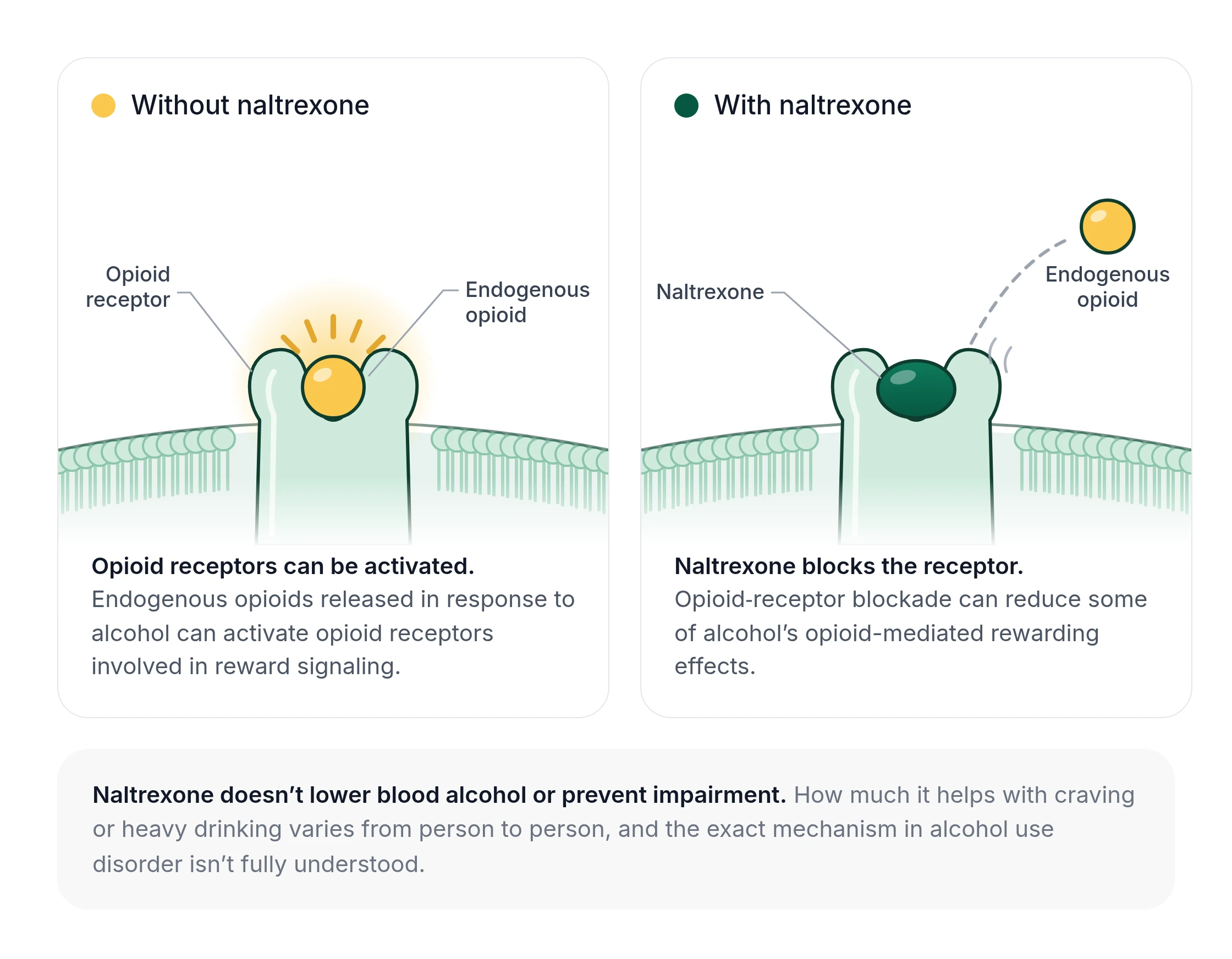
Start with the buzz. Alcohol’s rewarding effects involve several brain systems, including endogenous opioid signaling. Naltrexone blocks opioid receptors involved in this pathway and can reduce some of alcohol’s rewarding effects and, for some people, craving and heavy drinking. The exact mechanism in alcohol use disorder is not fully understood, and the effect varies among individuals.
Naltrexone is an opioid antagonist, which is a technical way of saying it parks on those receptors and blocks them (StatPearls, NIH). The endorphins show up and find the seats taken. By blocking opioid receptors involved in alcohol-related reward, naltrexone may make drinking feel less reinforcing for some people. With repeated treatment, this may contribute to reductions in craving or heavy drinking, although individual responses vary and the mechanism is not fully understood.
The craving part is slower, and this is where honesty matters. One proposed explanation is that repeatedly experiencing less reinforcement from alcohol may gradually weaken learned associations between drinking and reward. How much this contributes to reduced craving or drinking varies among individuals, and the mechanism remains incompletely understood. How well that holds varies a lot from person to person. It isn't dramatic. Most people just notice, one day, that alcohol matters less than it used to.
None of this is fringe. The FDA signed off on naltrexone for alcohol back in 1994, and an updated 2023 JAMA systematic review of 118 trials involving 20,976 participants found that oral naltrexone 50 mg/day and acamprosate had the strongest evidence among medications studied for alcohol use disorder. For oral naltrexone, the number needed to treat was about 18 to prevent one additional return to any drinking and about 11 to prevent one additional return to heavy drinking. Most studies included psychosocial treatment as well.
Do you have to quit drinking to start?#
No, and that one fact changes everything. One advantage of oral naltrexone is that abstinence from alcohol is not required before treatment begins for appropriately selected patients. That can make it useful for people whose immediate goal is to reduce heavy drinking rather than stop completely.
Another approach, sometimes called the Sinclair Method, uses naltrexone on a targeted basis in anticipation of drinking rather than as a fixed daily medication. This use is off-label, and evidence is more limited than for standard daily dosing. Whether targeted treatment is appropriate should be determined with the prescribing clinician.
So if what's kept you stuck is the thought of swearing off alcohol forever, that pressure isn't part of this. Cutting back counts. Sunflower's program meets you where you are, not where an all-or-nothing script says you should be.
How to get naltrexone online#
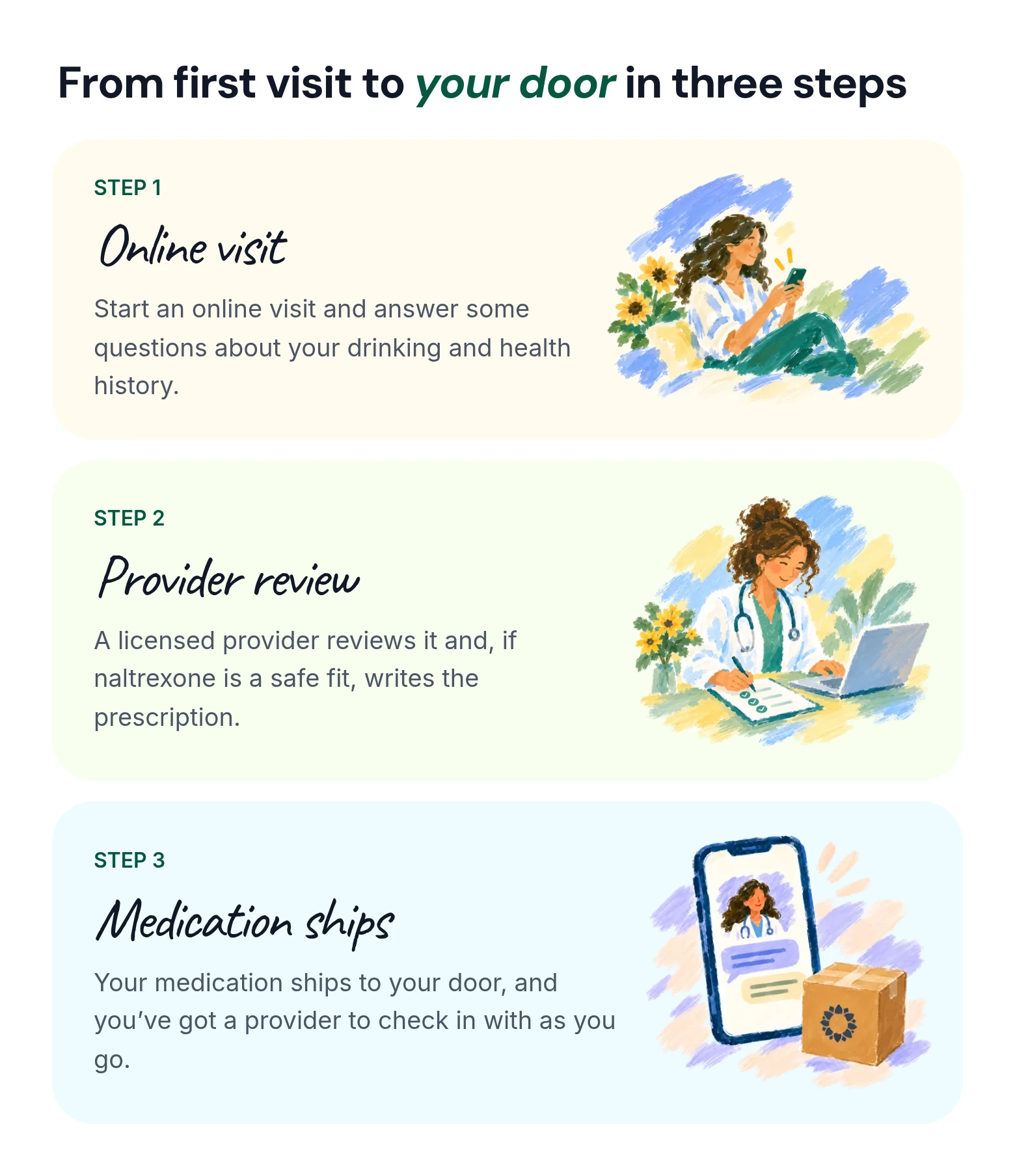
No waiting room, no referral. The telehealth path runs in three steps:
- Start an online visit and answer a few questions about your drinking and health history.
- A licensed provider reviews it, and if naltrexone is safe for you, writes the prescription.
- It ships to your door, and you've got a provider to check in with as you go.
The point is to kill the friction that keeps people out of treatment. No referral to chase, no rehab intake, nobody to explain yourself to across a desk.
Sunflower Clinic's naltrexone program puts the visit, the prescription, and the refills in one place. The intake is $20. If you're prescribed, it's $89 a month after that, billed quarterly.
Before you start, your provider walks you through the dose, the side effects, and the cost, so nothing blindsides you. If a craving hits while you're finding your footing, here's how to handle one in the moment, plus more on treating alcohol. When you're ready, you can see if you qualify in a few minutes.
What is the Sinclair Method?#
One off-label approach, sometimes called the Sinclair Method, uses naltrexone in anticipation of drinking rather than on a fixed daily schedule. Evidence for this targeted approach is more limited than for standard daily dosing, and whether it is appropriate should be determined with the prescribing clinician.
The proposed mechanism is sometimes called pharmacological extinction. The hypothesis is that repeatedly drinking with reduced opioid-mediated reinforcement may weaken learned associations between alcohol and reward over time. Whether and how much this reduces craving varies among individuals, and this mechanism remains incompletely established in humans.
You'll see a 78% success rate thrown around constantly. Be skeptical. It's a widely repeated claim, not a number from a controlled trial, and it's hard to trace where it actually came from.
The groups that quote it also define "success" loosely, more about feeling in control around alcohol than about quitting.
Here's the honest version: some controlled trials of taking naltrexone before drinking have shown less heavy drinking, but those studies are small and the results are mixed. It's a legitimate approach. It just isn't the sure thing the headline number makes it sound like, which is why it gets its own full write-up.
What's the usual naltrexone dosage for alcohol?#
The standard dose is 50 mg once a day, as a tablet. That's what most of the research runs on.
A few practical notes that make it go down easier:
- Some providers start at 25 mg for the first few days, then step up to 50 mg, which they find can ease early nausea.
- Taking it with food or a snack may help with stomach upset.
Sunflower uses a compounded tablet containing 45 mg of naltrexone with vitamin B6. This compounded combination is not FDA-approved, although naltrexone itself is FDA-approved for alcohol use disorder. FDA does not review compounded drugs for safety, effectiveness, or quality before they are marketed, and studies of standard 50-mg naltrexone do not directly establish the effectiveness of this exact compounded dose and formulation.
What are the side effects of naltrexone?#
Most people tolerate naltrexone fine, and when side effects do show up they're usually mild and most noticeable early on. Nausea is the one people report most, in roughly 1 in 10 people in the alcohol trials. After that it's the usual suspects: headache, dizziness, feeling a little wired, tiredness, trouble sleeping. Depression, suicidal thoughts, and suicide attempts have also been reported in people treated for alcohol or opioid dependence, although a causal relationship to naltrexone has not been established. New or worsening depression or suicidal thinking warrants prompt clinical evaluation.
The good part: they usually ease as your body adjusts. Taking the pill with food and starting low both help, though neither is spelled out in the label. In the two 12-week oral trials behind the FDA label, only a handful of people quit the drug over side effects, and when they did, nausea was the usual reason.
One rule you can't bend. Naltrexone must not be started while someone is using or physically dependent on opioids, including opioid pain medicines and tramadol. Current labeling recommends at least 7–10 opioid-free days after short-acting opioids; people transitioning from methadone or buprenorphine may remain vulnerable to precipitated withdrawal for up to two weeks. Trying to overcome naltrexone’s opioid blockade is dangerous, and opioid overdose risk can also increase after naltrexone is stopped because tolerance may be lower.
Can you drink alcohol while taking naltrexone?#
Yes, and this is where it gets confused with a different drug. Naltrexone is not Antabuse. Antabuse (disulfiram) makes you feel sick when you drink, sometimes badly. Naltrexone does nothing like that.
Naltrexone does not cause the alcohol-triggered aversive reaction associated with disulfiram. Targeted naltrexone protocols have therefore been studied in people who continue to drink, although they should not be interpreted as encouragement to drink and do not guarantee that cravings will decrease.
What it won't do is keep you sober or safe. Your blood alcohol climbs the same as ever. You can still get drunk, still be too impaired to drive. Naltrexone dulls the reward, not the alcohol. So the usual rules stand, and if you're drinking heavily, tell your provider how much. They can't help with a number they don't have.
Is naltrexone safe?#
For most people, at the normal dose, yes. It's been around for decades, it isn't addictive, and it isn't habit-forming, so none of the controlled-substance baggage comes with it.
The question that comes up most is the liver. Straight answer: at the standard dose, liver problems are uncommon. The worry traces to old studies that used far higher doses, and naltrexone once carried a boxed warning for liver injury.
The FDA pulled that warning in 2013. The original signal had come mostly from doses well above the 50 mg used for alcohol use disorder. Concern about liver injury arose largely from older studies using doses substantially higher than those typically used for alcohol use disorder. The FDA removed the boxed hepatotoxicity warning and former acute-hepatitis/liver-failure contraindication in 2013. More recent observational evidence, including studies in patients with cirrhosis, has been reassuring, but current labeling still warns about hepatitis and clinically significant liver dysfunction. Liver disease or abnormal liver tests may therefore affect whether and how naltrexone is used.
It's not right for everyone. It's a problem if you're using opioids or might need opioid painkillers, it needs a closer look with acute liver trouble, and it's a conversation if you're pregnant or breastfeeding. None of that is yours to sort out alone. The screening visit exists to catch it before you ever take the first pill.
Common questions#
How long does naltrexone take to work?#
After an oral dose, peak blood levels of naltrexone and its major metabolite occur within about an hour. Targeted-treatment studies have generally administered naltrexone before anticipated drinking, but the optimal targeted regimen has not been established as an FDA-approved dosing strategy.
How long do you stay on naltrexone?#
There's no fixed stop date. Some people take it for a few months, others much longer. Targeted naltrexone protocols may use the medication in anticipation of drinking rather than every day; the appropriate regimen and duration should be determined with the prescribing clinician. There is no single treatment duration that is right for everyone. Your clinician can help decide how long to continue it and when to stop. Naltrexone generally does not require tapering because it does not cause physiologic dependence.
Is naltrexone addictive?#
No. It isn't a controlled substance, it produces no high, and stopping it causes no withdrawal of its own. The withdrawal risk you may have heard about is a different thing: it's about starting naltrexone while opioids are still in your system.
Does naltrexone cause weight loss?#
Not on its own, and it isn't approved for it. Some people do notice a smaller appetite. There's a separate combination product that pairs naltrexone with another drug for weight management, but that's a different thing from naltrexone for alcohol.
Do you need a prescription?#
Yes. It's prescription-only, which is why the online visit and provider review are part of the deal.
References#
- Singh D, Saadabadi A. Naltrexone. In: StatPearls. Treasure Island, FL: StatPearls Publishing; updated May 30, 2023. https://www.ncbi.nlm.nih.gov/books/NBK534811/. Accessed October 24, 2026.
- Naltrexone hydrochloride tablets. Prescribing information (US FDA label). https://dailymed.nlm.nih.gov/dailymed/drugInfo.cfm?setid=06ff2d5a-e62b-4fa4-bbdb-01938535bc65. Accessed October 24, 2026.
- McPheeters M, O’Connor EA, Riley S, et al. Pharmacotherapy for Alcohol Use Disorder: A Systematic Review and Meta-Analysis. JAMA. 2023;330(17):1653-1665. doi:10.1001/jama.2023.19761.
- Thompson R, Taddei T, Kaplan D, Rabiee A. Safety of naltrexone in patients with cirrhosis. JHEP Rep. 2024;6(7):101095. doi:10.1016/j.jhepr.2024.101095.