
A craving does not wait until you are ready for it, it builds an hour before the drink you planned, or lands out of nowhere on a quiet afternoon. That pull runs on brain chemistry sitting underneath whatever you decide to do about it, which is a big part of why deciding harder so often fails.
Naltrexone works one level down, on the chemistry itself: it is thought to blunt some of the reward your brain gets from drinking, and for many people the urge gets quieter and easier to let pass.
The effect is real and well studied: it does more to cut heavy drinking than to switch cravings off entirely.
What's happening when you crave a drink#
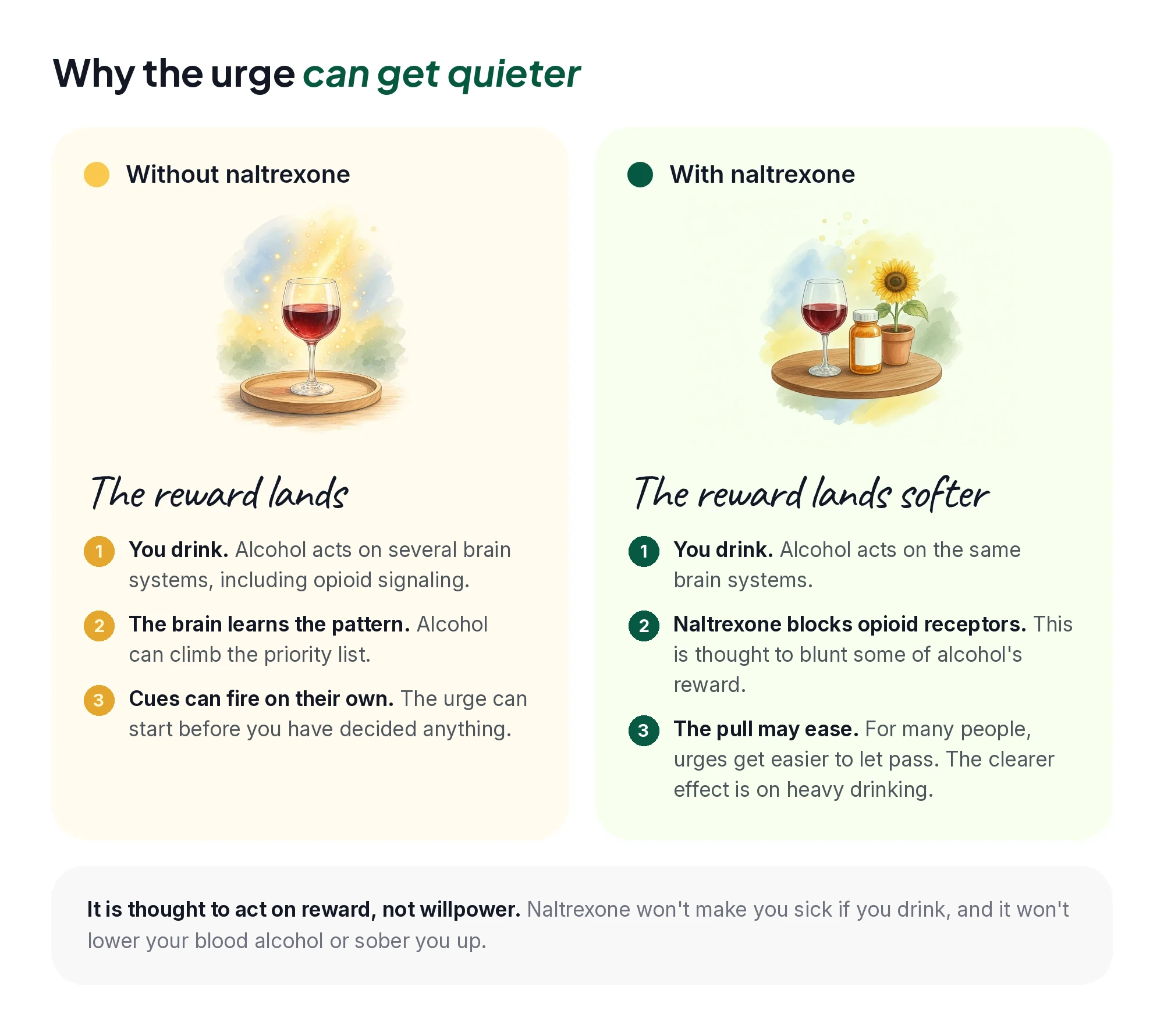
Alcohol affects several brain systems involved in reward, learning, and stress, including the endogenous opioid system, the brain's own opioid signaling.
Drink often enough and the brain can learn the pattern: alcohol climbs the priority list, and cues to drink can start firing on their own, before you have consciously decided anything.
That is also why willpower runs out: you are pushing against a system built to make drinking feel important, and that system does not stand down because you told it to.
For tactics in the moment an urge hits, we wrote a separate guide on how to manage a craving in real time, there is also a piece on why the craving is often about the state you are chasing, not the drink itself. This article is about the medication side.
What naltrexone does to the urge#
Naltrexone is an opioid-receptor blocker. By blocking opioid receptors, naltrexone is thought to reduce some of alcohol's rewarding and reinforcing effects. In laboratory studies, its average effect on craving is statistically significant but modest.
Unlike disulfiram, it is not aversive, so it will not make you sick when you drink, it also will not sober you up or lower your blood alcohol, which means it does nothing for coordination or judgment behind the wheel.
Naltrexone is not a controlled substance and is not known to cause physiologic dependence or a characteristic withdrawal syndrome when it is discontinued. For oral naltrexone, you generally do not have to be completely abstinent from alcohol before starting, but you must be opioid-free.
It is FDA-approved for alcohol use disorder, and the American Psychiatric Association recommends offering it, or acamprosate, as a first-choice medication to people with moderate to severe alcohol use disorder.
For the longer backstory, we cover it in naltrexone and alcohol use disorder: history and evidence. You can read about our naltrexone program and pricing.
How much it actually helps#
In a 2023 systematic review of 118 clinical trials, oral naltrexone 50 mg a day reduced the risk of returning to heavy drinking. About 11 people needed treatment to prevent one additional return to heavy drinking compared with placebo; for preventing any return to drinking, the number was about 18 (heavy drinking is usually defined as about 4 or more drinks in a day for women, 5 or more for men, though trials varied).
On the craving itself, the effect is small: in the lab studies that measured craving head to head against placebo, naltrexone still came out ahead, with an effect about the same size as its effect on drinking in those studies. For most people, it takes the edge off the urge rather than switching it off.
Naltrexone shifts the odds, and for many people that shift is what makes the rest of the work stick.
It also tends to work best when it is not carrying the whole load: in major trials, naltrexone has been given alongside regular check-ins or support, although adding formal counseling has not always improved results further. That can be formal therapy, a peer group, or the kind of ongoing support that keeps you on it long enough to judge whether it helps.
How soon you would notice#
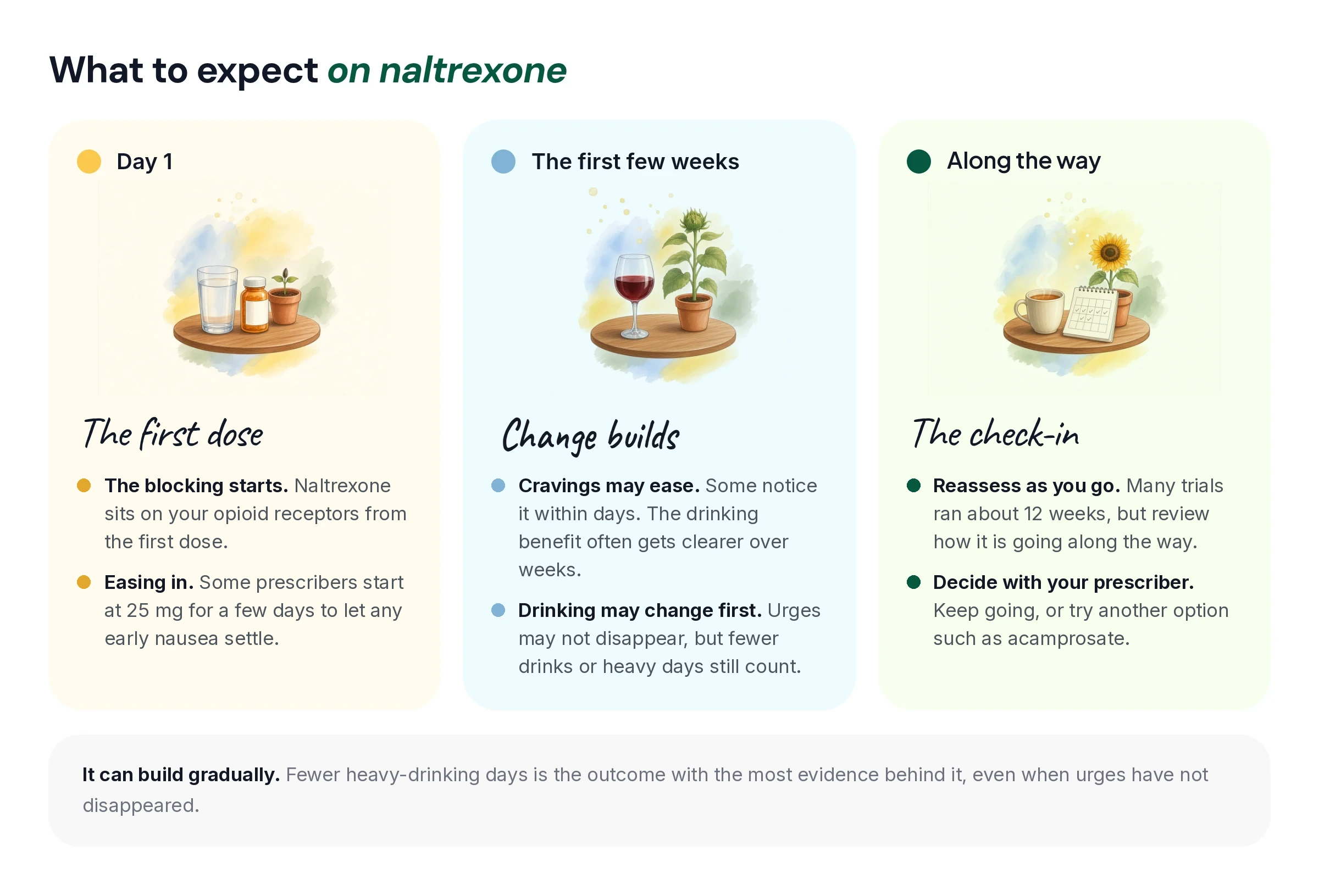
The receptor blocking starts with the first dose, and some people notice cravings easing and drinking feeling less rewarding within days, though the benefit on drinking often becomes clearer over the first few weeks of regular use.
Many efficacy trials studied oral naltrexone 50 mg daily for about 12 weeks. Response and side effects should be reassessed during treatment rather than waiting for a fixed 12-week point, and some people continue treatment longer when it remains helpful.
Some people have less change in craving than in their actual drinking behavior. A treatment benefit may therefore show up as fewer drinks or fewer heavy-drinking days even when urges have not disappeared. That still counts, and fewer heavy days is the outcome with the most evidence behind it.
Who it tends to help, and who it does not#
In lab studies, naltrexone modestly reduced craving and drinking in both people who drink heavily and people with diagnosed alcohol use disorder, so you may not need to be at your worst for it to be worth discussing.
Exploratory studies suggest that people whose drinking is driven more by alcohol's rewarding effects may respond particularly well to naltrexone. This finding is not yet established well enough to use as a routine clinical rule for deciding who should or should not receive the medication.
It is not for everyone. Naltrexone cannot be started while you are taking opioid medications or are physically dependent on opioids. People previously using short-acting opioids generally need an opioid-free interval of at least 7 to 10 days; withdrawal risk can persist longer after methadone or buprenorphine.
Starting too soon can cause severe precipitated withdrawal, sometimes requiring hospital care. Tell your clinician about all opioid-containing medications, including pain medicines and tramadol.
After naltrexone is stopped, opioid tolerance may be lower, which can increase overdose risk if opioids are resumed. Naltrexone also blocks the effects of opioid medications and drugs. Trying to overcome that blockade by taking larger amounts of opioids is dangerous and can result in life-threatening or fatal overdose.
Naltrexone does not prevent or treat alcohol withdrawal. If you drink heavily or have had withdrawal symptoms or seizures before, do not assume that starting naltrexone makes it safe to stop drinking abruptly; withdrawal risk should be assessed by a clinician.
Our page on clinical safety covers it, and if withdrawal is severe, with shakes, sweats, confusion, or seizures, get medical help right away by calling 911 or going to an emergency room.
One more honest point about the support side: the gap between leaving one level of care and starting the next is where a lot of people slip, which is the whole subject of what we hand clients between levels of care. If a peer group is part of your plan, we also wrote a first-timer's guide to support groups.
Starting naltrexone#
Naltrexone is prescription-only. Before starting it, a clinician should review your opioid use, other medications, alcohol-withdrawal risk, and relevant medical history, including liver disease. Liver testing may be appropriate based on your history and clinical circumstances.
Naltrexone can rarely be associated with liver injury, so contact your clinician promptly if you develop symptoms that could suggest liver problems, such as yellowing of the skin or eyes, dark urine, or persistent upper abdominal pain.
The standard dose is 50 mg once a day, though some prescribers start at 25 mg for a few days to let any early nausea settle before moving up to 50 mg. Nausea is the most common side effect, usually mild and usually short-lived, with headache and dizziness behind it.
One option worth asking about, though it isn't the labeled regimen: targeted naltrexone, taken in anticipation of a high-risk drinking situation, has been studied in selected populations, including a 2022 randomized trial in men with mild to moderate alcohol use disorder, and may reduce drinking for some people.
However, this is an off-label strategy with a smaller evidence base than daily dosing, and studies have not established that it is generally equivalent to daily treatment. The dose and timing should be determined with a prescriber.
If drinking has stopped being something you control, and you want the pull itself to get weaker, naltrexone is one of the most studied tools for the job. If you are considering naltrexone, a licensed clinician can assess whether it is appropriate for you, including your opioid exposure, alcohol-withdrawal risk, other medications, and relevant medical conditions. You can read more on our naltrexone program page.
Questions people ask before starting naltrexone#
Does naltrexone stop alcohol cravings completely?#
Usually not completely. Naltrexone may take the edge off the urge and make it easier to ride out for some people, but it doesn't switch cravings off. The bigger, better-documented effect is on how much you drink once a craving does hit.
How long does naltrexone take to work on cravings?#
The receptor blocking begins with the first dose, but the noticeable drop in cravings and drinking usually builds over the first few weeks. Many trials studied about 12 weeks of treatment, but response and side effects should be reassessed along the way rather than waiting for a fixed point.
Can you drink alcohol while taking naltrexone?#
For oral naltrexone, you generally do not have to be completely abstinent from alcohol before starting. However, a clinician should first assess whether reducing or stopping alcohol could trigger withdrawal. The FDA labeling for extended-release injectable naltrexone differs and specifies abstinence before the first injection. Naltrexone will not make you ill the way disulfiram does. It also will not reduce impairment, so it is no safer to drive after drinking while on it.
Is naltrexone addictive?#
Naltrexone is not a controlled substance and is not known to cause physiologic dependence or a characteristic withdrawal syndrome when it is discontinued.
How long do you stay on it?#
Many people take it for around three months to start, then reassess with their prescriber. Some stay on longer; there is no fixed finish line, and stopping is not known to cause a withdrawal syndrome.
What if it does not help my cravings?#
It does not work for everyone, and that is worth saying plainly. If naltrexone is not moving anything after a fair trial, there are other options, including acamprosate, and the next step is a conversation with your clinician rather than giving up on medication altogether.
References#
- Naltrexone hydrochloride tablet, film coated [prescribing information]. DailyMed, U.S. National Library of Medicine. Accessed October 29, 2026. https://dailymed.nlm.nih.gov/dailymed/drugInfo.cfm?setid=b09b4b5e-795a-48e7-b7cc-2e29f41c5660
- Reus VI, Fochtmann LJ, Bukstein O, et al. The American Psychiatric Association practice guideline for the pharmacological treatment of patients with alcohol use disorder. Am J Psychiatry. 2018;175(1):86-90. doi:10.1176/appi.ajp.2017.1750101
- McPheeters M, O'Connor EA, Riley S, et al. Pharmacotherapy for alcohol use disorder: a systematic review and meta-analysis. JAMA. 2023;330(17):1653-1665. doi:10.1001/jama.2023.19761
- Jonas DE, Amick HR, Feltner C, et al. Pharmacotherapy for adults with alcohol use disorders in outpatient settings: a systematic review and meta-analysis. JAMA. 2014;311(18):1889-1900. doi:10.1001/jama.2014.3628
- Ray LA, Green RJ, Roche DJO, Magill M, Bujarski S. Naltrexone effects on subjective responses to alcohol in the human laboratory: a systematic review and meta-analysis. Addict Biol. 2019;24(6):1138-1152. doi:10.1111/adb.12747
- Santos GM, Ikeda J, Coffin P, et al. Targeted oral naltrexone for mild to moderate alcohol use disorder among sexual and gender minority men: a randomized trial. Am J Psychiatry. 2022;179(12):915-926. doi:10.1176/appi.ajp.20220335
- Initiation of naltrexone for alcohol use disorder. Boston Medical Center, Grayken Center for Addiction Training and Technical Assistance. Updated June 14, 2024. Accessed October 29, 2026. https://addictiontraining.org/documents/resources/318_Initiation_of_Naltrexone_for_Alcohol_Use_Disorder.pdf
- Naltrexone for alcohol use disorder [patient pamphlet]. Nova Scotia Health. Accessed October 29, 2026. https://www.nshealth.ca/sites/default/files/documents/pamphlets/2263.pdf