
You can get naltrexone without ever sitting in a waiting room: complete a five-minute online health questionnaire, have a licensed doctor review it through telehealth, and, if naltrexone is a safe fit, get the medication shipped discreetly to your door, depending on your state and your clinical situation.
That works because naltrexone isn't a controlled substance, so in many states a licensed doctor can evaluate and prescribe it entirely online. For people who want evidence-based help to cut back or stop drinking but can't or don't want to go through an in-person clinic, that makes it one of the more accessible medication options for alcohol use disorder.
It isn't instant, and it isn't right for everyone, but the path is shorter than most people expect. Here's how it works, starting with what the medication actually is.
What is naltrexone?#
Naltrexone is a prescription medication that lowers the pull of alcohol. You take it as prescribed, usually once a day. It blunts alcohol's rewarding effects and reduces cravings, and many people find that over weeks they drink less.
It's FDA-approved, it's not addictive, and you don't have to stop drinking before you start, though anyone at risk of alcohol withdrawal needs medical detox first. You do need to be opioid-free for at least 7 to 10 days, and up to 2 weeks if you're coming off buprenorphine or methadone.
It has been approved for alcohol use disorder since 1994, which makes it one of the oldest and most studied medications for alcohol use disorder available. Most people who drink too much have tried to stop on willpower alone, and for a lot of them it works for a stretch and then stops working.
Naltrexone acts on the reward pathway directly, which is why it can help people for whom willpower hasn't been enough, including those who went to AA or a support group and found it didn't hold.
It's prescription-only and not sold over the counter, but it isn't a controlled substance. You can't get high on it, and there's no abuse or diversion potential, so the DEA doesn't schedule it, and its FDA label lists its DEA schedule as none. That single fact is what makes the online route possible, which we come back to below. If you want the longer story on how it works and what the research shows, we go into it in the history and evidence behind naltrexone.
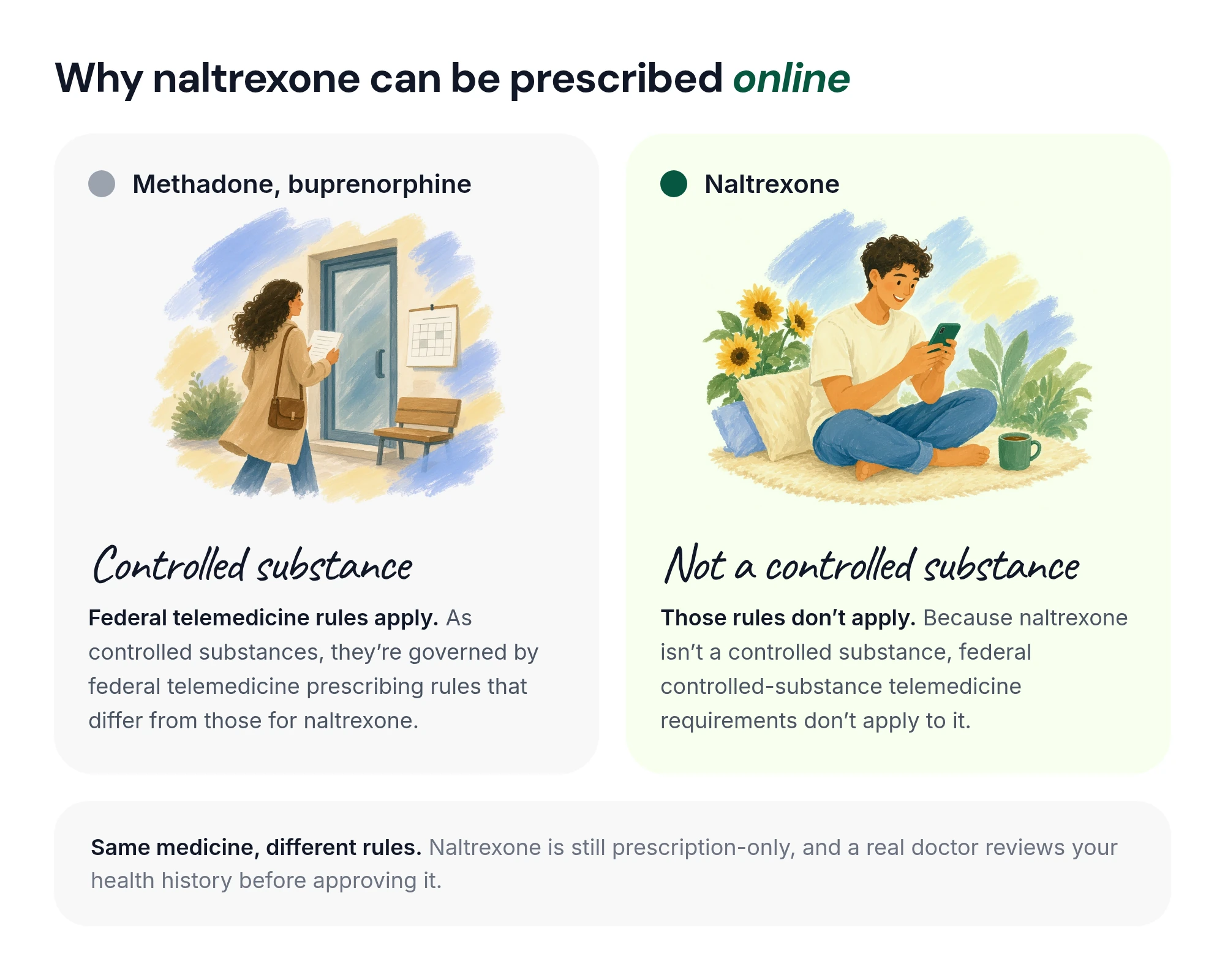
Two panels: methadone and buprenorphine are controlled substances and are governed by federal telemedicine prescribing rules that differ from those for naltrexone. Because naltrexone is not a controlled substance, federal controlled-substance telemedicine requirements do not apply to it.
How to get naltrexone online in 3 steps#
Here's the whole path, from the first form to the bottle in your hand.
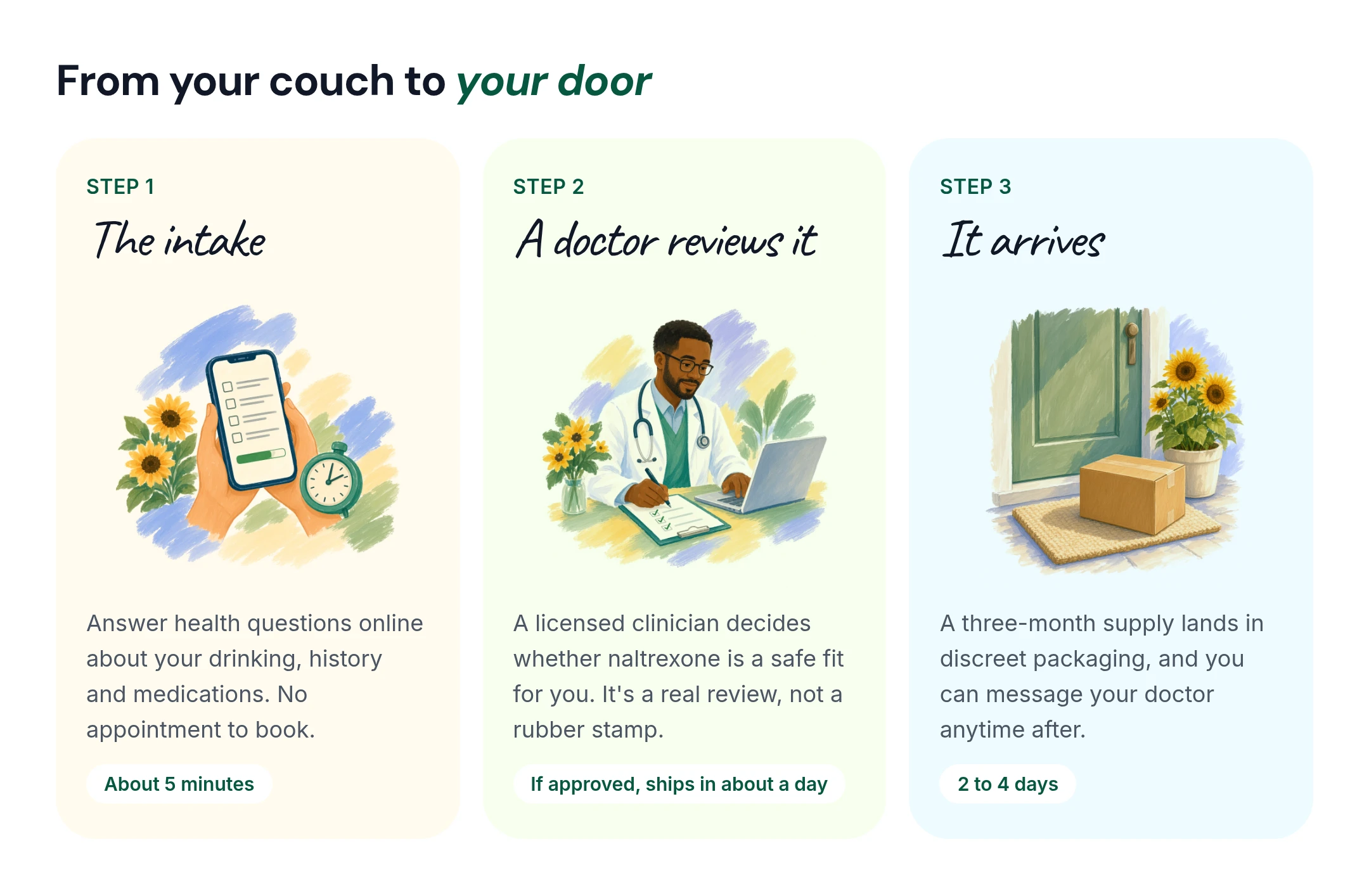
Step 1: The intake, about five minutes. You complete an online assessment covering your drinking, your medical history, and your current medications, and you can save it and come back if you need to. Getting naltrexone through Sunflower starts with a $20 clinical assessment at this step.
Step 2: A doctor reviews it. A licensed clinician reads your answers and decides whether naltrexone is a safe fit for you. It's a real medical review, which is also why approval isn't guaranteed. If you're cleared, a three-month supply ships in discreet packaging, usually within a day.
Step 3: It arrives, and you're not on your own. The medication lands in two to four days, and after that you can message your doctor about side effects or dosing, with follow-up check-ins scheduled to see how well treatment is working. Therapy is there if you want it and completely optional. That kind of ongoing support matters, because recovery usually slips in the gaps between levels of care, when one stage ends before the next picks up.
The one thing the process can't skip is your location, since a clinic can only prescribe where it's licensed, so step zero is really checking whether your state is covered.
Naltrexone can reduce alcohol cravings and the odds of heavy drinking, though how much it helps varies from person to person. Riding out a craving in the moment, or working out what you actually miss when you stop drinking, is where the care team earns its keep, and our guide to managing a craving in real time covers the in-the-moment part.
Three steps from your couch to your door: a five-minute online intake, a licensed doctor's review, and a three-month supply arriving in two to four days.
What you actually get#
The standard form of naltrexone is a plain 50 mg tablet, which is what most pharmacies hand over, while the injectable form is given by a provider every 28 to 30 days.
Sunflower's program uses a compounded tablet with 45 mg of naltrexone and 5 mg of vitamin B6, made by a licensed US pharmacy. It uses naltrexone, the active ingredient in FDA-approved products, but this combination and dose have not been reviewed by FDA. The finished tablet itself is not FDA-approved, and most of the research was done on the 50 mg tablet.
You get a three-month supply of the program's tablets at a time, so you're not chasing a refill every few weeks.
What naltrexone costs#
The pricing is two numbers: twenty dollars for the clinical assessment up front, then $89 a month if a doctor approves you, billed every three months so a fresh supply is always on the way. There's no contract and no long commitment, and you can cancel anytime.
That flat price folds in the medication, the pharmacy, and your care team. For context, naltrexone can cost more through other routes, since generic oral naltrexone usually runs about $30 to $80 a month with a pharmacy discount card (higher at full cash price) and Vivitrol injections can run $1,200 to $2,500 a month without insurance, with prices varying by pharmacy and location.
Because the compounded tablet isn't individually FDA-approved, insurance usually won't cover it, which is the honest reason behind a cash price. Standard generic naltrexone, on the other hand, is often covered partially or fully, though what you pay depends on your plan, so it's worth checking your benefits before you choose a route. Patient assistance programs can help too.
Who should and shouldn't take naltrexone#
The online route is limited by geography first. Sunflower prescribes in eight states right now: Connecticut, Florida, Georgia, Hawaii, Michigan, Pennsylvania, Utah, and Washington. If you live elsewhere, you're on a waitlist until coverage reaches you.
The biggest safety issue is opioid use. Naltrexone is also used for opioid dependence and opioid addiction, but because it blocks opioid receptors, it can trigger sudden, severe opioid withdrawal if opioids are still in your system. You need to be opioid-free for 7 to 14 days before starting, and the interval can be longer after methadone or buprenorphine, so your clinician may ask for more history or testing before deciding it's safe to begin.
Naltrexone also changes your opioid tolerance, which means that after you stop taking it, or as its blocking effect wears off, an amount of opioids you used to tolerate can cause a life-threatening overdose. Don't try to override the blockade by taking more opioids, and tell any clinician treating you for pain that you're on naltrexone.
Your liver matters too, since naltrexone is processed by the liver and can raise liver enzymes, so clinicians may review your liver health and health history or order liver function tests before starting treatment.
One safety point is bigger than naltrexone itself. If you're a heavy daily drinker, don't quit cold on your own to get ready for it, because stopping suddenly after heavy, sustained drinking can cause seizures and is genuinely dangerous. Severe alcohol withdrawal is a medical emergency, so call 911. And if you're in crisis or thinking about hurting yourself, call or text 988.
One myth worth correcting: you don't have to be sober, or even sure you want to quit, to start. When it's clinically appropriate, naltrexone can be started while you're still drinking, and it can support either cutting back or stopping altogether. What you do need is to be stable enough to start safely, which is exactly what the doctor's review is for.
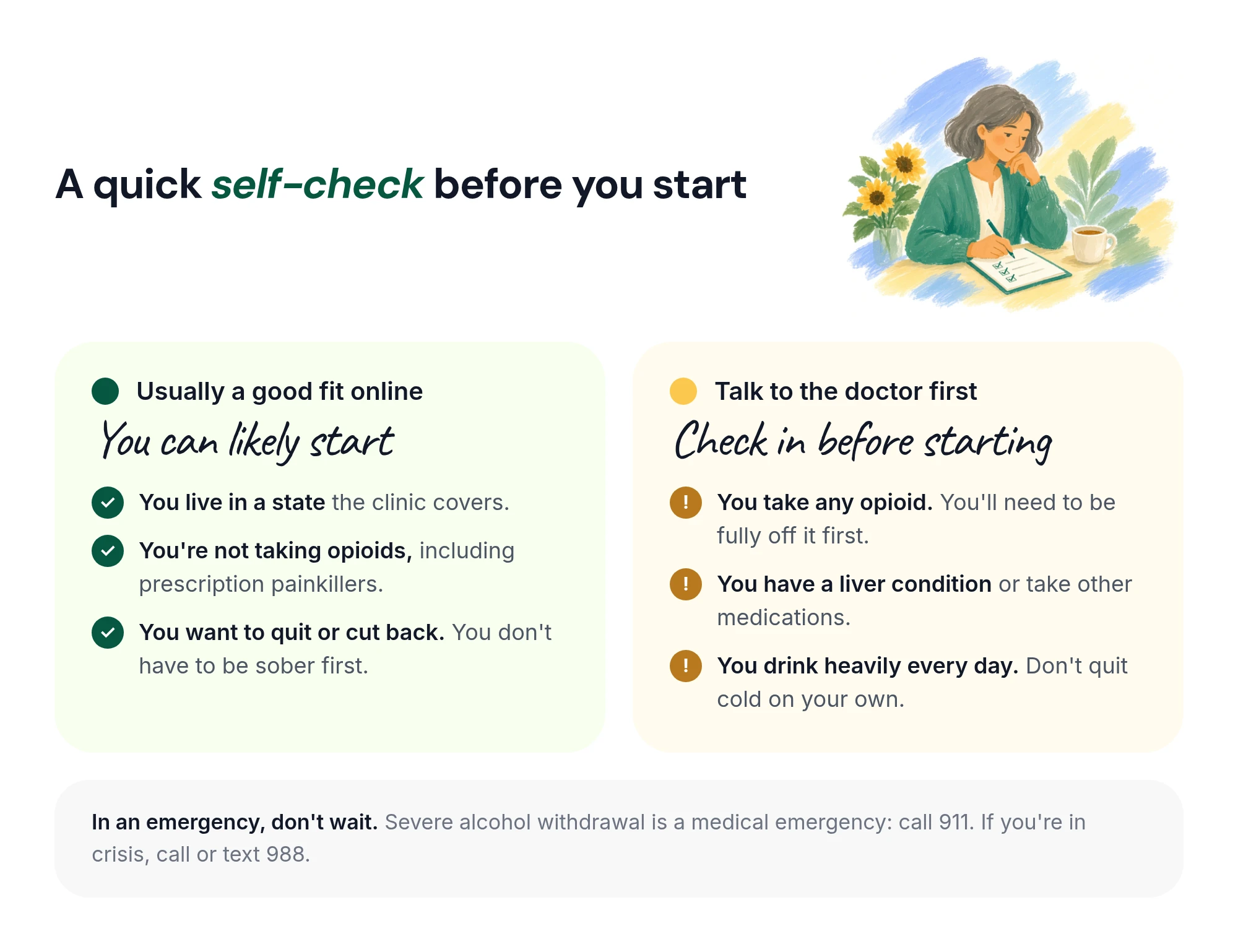
Self-check. Usually a good fit online: you live in a covered state, aren't taking opioids, and want to quit or cut back. Talk to the doctor first if you take any opioid, have a liver condition or take other medications, or drink heavily every day.
What naltrexone won't do#
Naltrexone won't flip a switch in your head, and it won't erase the habit, the stress, or the reasons you reach for a drink in the first place, which are still yours to work on. It's generally used as part of a broader treatment plan, so counseling, medical follow-up, or peer support can all help, in whatever mix works for you.
Common naltrexone side effects include nausea, headache, dizziness, fatigue, trouble sleeping, stomach upset, and anxiety. For many people these ease within a few days to weeks, but tell your clinician if they persist or bother you. Taking the tablet with food can help with nausea, and anything persistent or severe is worth raising with your clinician.
It also doesn't treat alcohol withdrawal, so if withdrawal symptoms show up when you try to stop drinking, contact a healthcare professional. For some people the change is clear within weeks, fewer cravings and fewer heavy nights, while for others it's smaller and takes longer to show.
Naltrexone isn't a cure, and the response varies from person to person, but it's an evidence-based medication that clinicians have used for alcohol use disorder for decades.
If you live in a state Sunflower serves, you can complete the online intake to request a clinician review, and a prescription follows only if the reviewing clinician decides naltrexone is appropriate and safe for you.
Some people need more information, testing, or a different level of care first, and if that's you, you can still start the intake now and let the review sort out the path.
This article provides general educational information and is not a substitute for individualized medical advice. Naltrexone requires a prescription and is not appropriate for everyone. A licensed clinician must determine whether treatment is appropriate based on your medical history, medications, substance use, and other relevant factors.
Questions people ask before they start#
Do you need a prescription for naltrexone?#
Yes. Naltrexone is prescription-only, but it isn't a controlled substance, so a licensed clinician can often prescribe it through telehealth without an in-person exam, depending on your state and clinical situation.
Is an online naltrexone prescription legit?#
Yes. Because naltrexone isn't a controlled substance, the federal in-person examination requirements that apply to controlled-substance prescribing don't apply to it, so depending on state law and your clinical circumstances a licensed clinician can evaluate and prescribe it entirely through telehealth.
Do I need insurance or a referral?#
No. You don't need a referral and you don't go through insurance: you start the intake yourself, pay a $20 assessment, and if a clinician prescribes naltrexone, pay for a plan directly, either $89 a month billed every three months or $64 a month billed yearly.
How fast does it arrive?#
The intake takes about five minutes, and if a doctor approves you the medication usually ships within a day and arrives in two to four days.
Do I have to stop drinking before I start?#
No. You don't have to be sober or even set on quitting, and naltrexone can support cutting back as well as stopping. The one caution is that if you're a heavy daily drinker you shouldn't stop suddenly on your own, since that can be dangerous, and the doctor will help you start safely.
Which states can I get it in?#
Eight so far: Connecticut, Florida, Georgia, Hawaii, Michigan, Pennsylvania, Utah, and Washington. More are on the way, and you can join a waitlist if yours isn't live yet.
Can I actually talk to a doctor?#
Yes. Once you're approved, you can message your doctor or another healthcare professional about dosing, side effects, and progress as part of ongoing care. Naltrexone is an FDA-approved medication for alcohol and opioid use disorders, and if your prescriber doesn't have much experience treating substance use disorders they can point you to someone who does. Someone is available seven days a week.
References#
- Naltrexone hydrochloride tablet, film coated. DailyMed. US National Library of Medicine. https://dailymed.nlm.nih.gov/dailymed/drugInfo.cfm?setid=b09b4b5e-795a-48e7-b7cc-2e29f41c5660. Accessed October 26, 2026.
- Compounding and the FDA: Questions and Answers. US Food and Drug Administration. https://www.fda.gov/drugs/human-drug-compounding/compounding-and-fda-questions-and-answers. Accessed October 28, 2026.
- Naltrexone. Substance Abuse and Mental Health Services Administration. https://www.samhsa.gov/substance-use/treatment/options/naltrexone. Updated December 12, 2025. Accessed October 26, 2026.
- Center for Substance Abuse Treatment. Incorporating Alcohol Pharmacotherapies Into Medical Practice. Treatment Improvement Protocol (TIP) Series, No. 49. Rockville, MD: Substance Abuse and Mental Health Services Administration; 2009. https://www.ncbi.nlm.nih.gov/books/NBK64042/. Accessed October 26, 2026.
- Jonas DE, Amick HR, Feltner C, et al. Pharmacotherapy for adults with alcohol use disorders in outpatient settings: a systematic review and meta-analysis. JAMA. 2014;311(18):1889-1900. doi:10.1001/jama.2014.3628