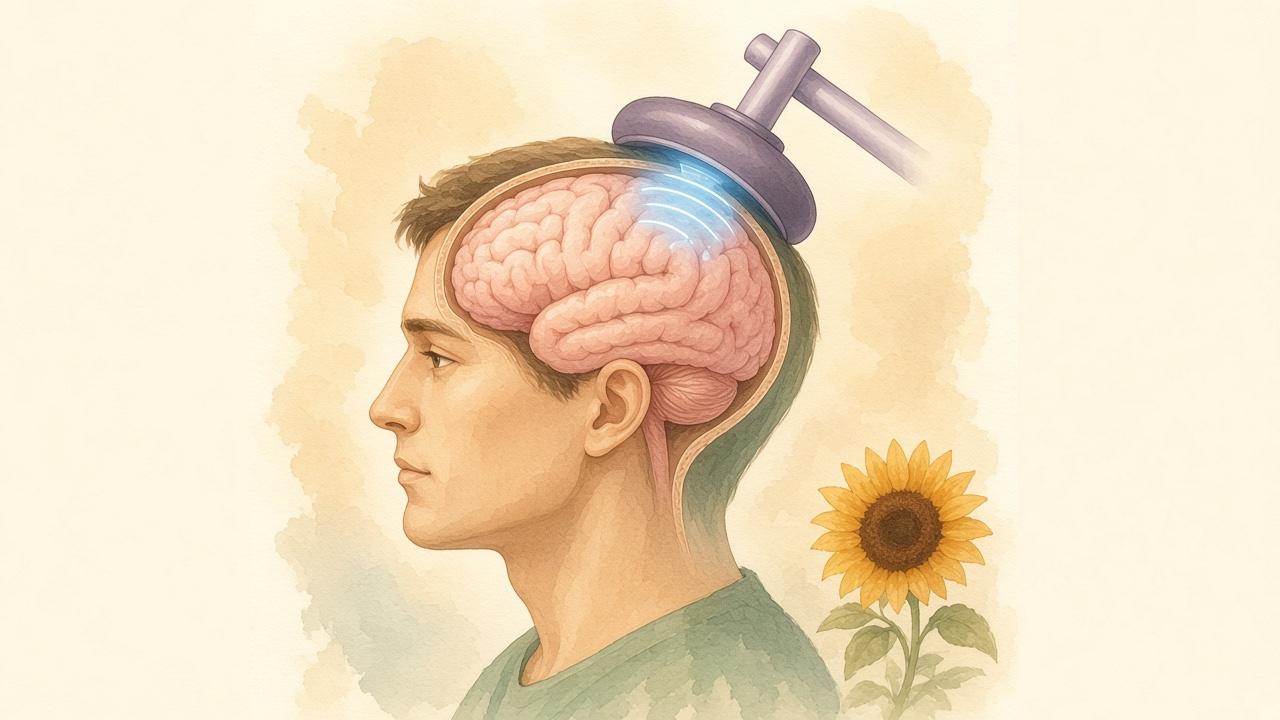
Transcranial magnetic stimulation (TMS) is a technique used in psychiatry, FDA-cleared for depression, OCD and smoking cessation, and studied for other mental health conditions,,. It uses magnetic pulses to create electrical current in certain brain areas, which can either enhance or quiet down how they interact with other brain regions to influence behavior,.
How TMS Targets the Brain's "Brake" in Addiction#
One brain region that is targeted frequently by TMS is the dorsolateral prefrontal cortex (dlPFC). This area is important for executive functioning, decision making, and seemingly acts as a “brake” on risky behaviors,. In this way, the dlPFC is closely involved in addiction and reward-seeking behavior. People who are struggling with substance use may have difficulty resisting cravings, despite knowing that there are adverse consequences. This may be in part due to alterations in how the dlPFC is sending messages to the rest of the brain.
Is TMS FDA-Cleared for Addiction?#
Deep TMS, which uses specialized coils to stimulate broader networks of the brain, has received FDA clearance as an aid for short-term smoking cessation in adults,,,,. Research is also investigating TMS for alcohol, cocaine, and methamphetamine use disorders, although these applications remain investigational,,.
What Recent Research on TMS Shows#
A 2026 randomized clinical trial found that stimulation of the left dlPFC reduced cigarette consumption more effectively than sham stimulation (placebo treatment), with accompanying changes in the activity of this brain region. These findings support the hypothesis that strengthening the dlPFC’s ability to provide a brake on other areas of the brain may help reduce addictive behavior. However, long-term efficacy, optimal stimulation protocols, and the durability of treatment effects require further investigation.
Deep Brain Stimulation (DBS) for Addiction#
Another interventional technique known as deep brain stimulation (DBS) is more invasive than TMS and targets deeper regions in the brain. It involves implanting electrodes into these regions and requires surgery.
What DBS Research Shows, and Its Risks#
The nucleus accumbens is an area of the brain known to play an important role in addiction and reward-seeking behavior. As discussed in previous articles on GLP-1s and addiction and brenipatide, it receives signals from the ventral tegmental area (VTA) through the “feel good” chemical of our brain known as dopamine. Small clinical studies involving severe alcohol and opioid use disorders have reported reductions in craving and substance consumption following stimulation of the nucleus accumbens or adjacent brain areas,. However, most studies have involved very small samples, and controlled evidence remains limited. As mentioned, DBS is a more invasive technique requiring neurosurgery, thus there are more risks associated with it, including infection and hemorrhage (excessive bleeding),,. Because of these risks, DBS is not an established treatment for addiction and is currently most appropriately investigated within carefully monitored research settings.
Low-Intensity Focused Ultrasound (LIFU) for Addiction#
Another emerging technology with potential applications in addiction is low-intensity focused ultrasound (LIFU). It uses targeted acoustic energy to influence brain activity. This is a less invasive technique compared to DBS. Researchers have begun investigating whether LIFU can target brain areas involved in addiction, including the nucleus accumbens, in patients with substance use disorders. Early pilot studies in opioid use disorder have reported reductions in cravings induced by triggers, or cues, following targeted stimulation,. These findings are preliminary, however, and larger sham-controlled trials are necessary to establish efficacy and safety. Importantly, non-ablative LIFU differs from high-intensity focused ultrasound procedures that create permanent lesions. These approaches have different mechanisms, risks, and potential clinical applications.
Ketamine as a Potential Treatment for Addiction#
You may have heard of ketamine as a treatment for depression, though it is also used recreationally. Esketamine (Spravato), a related nasal spray, is FDA-approved for treatment-resistant depression, while ketamine itself is used off-label. It has now attracted attention as a potential treatment for addiction. Clinical studies have investigated ketamine, sometimes combined with psychotherapy, for alcohol, cocaine, and opioid use disorders,,. A 2025 systematic review identified encouraging findings across several substance use disorders, although studies varied substantially in design, dosing, and outcomes. Ketamine itself also has misuse potential and can cause dissociation, cardiovascular effects, and other adverse reactions. Its use for addiction remains investigational, and it should not be considered a replacement for established treatments such as buprenorphine or methadone for opioid use disorder.
Psilocybin and Psychedelics for Addiction#
You have also probably heard about psychedelics, such as psilocybin, being investigated to treat psychiatric disorders and substance use disorders. It is ironic that substances themselves may be used to treat substance use disorders. However, psilocybin has shown some evidence that it may be useful. A randomized trial involving patients with alcohol use disorder (AUD) found that psilocybin-assisted psychotherapy reduced heavy drinking compared with an active-placebo condition. Smaller studies have also explored psilocybin-assisted treatment for tobacco use disorder. However, psychedelic treatments present important limitations, with uncertain long-term outcomes, and potential psychiatric risks, particularly in individuals vulnerable to psychosis. Psilocybin is not FDA-approved for addiction treatment.
It is important to note that ketamine and psychedelics are mind-altering substances and should only be used to treat substance use disorders in a controlled research setting.