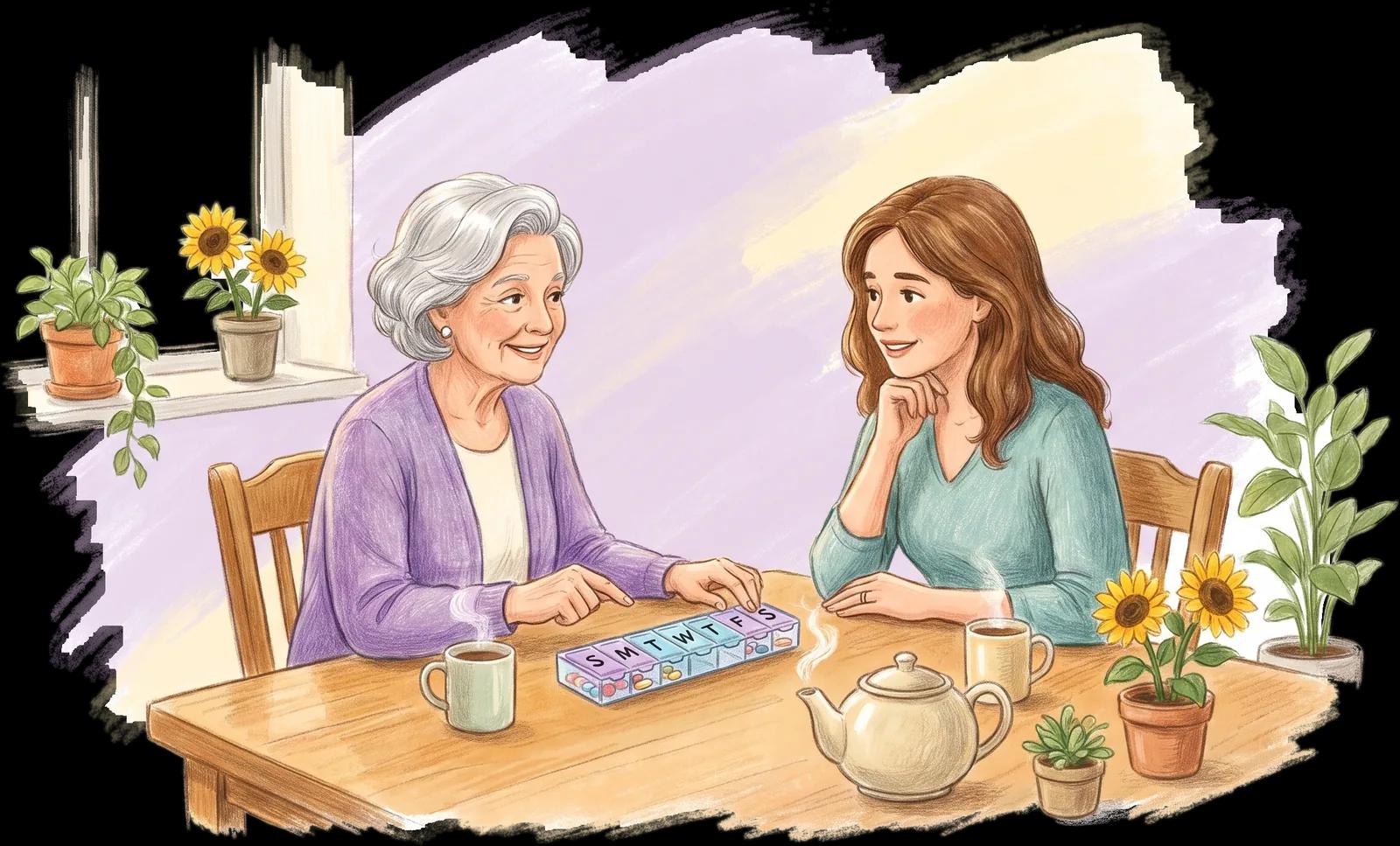
About 80% of people aged 65 and older took a medication in the past year that could interact with alcohol, according to NIAAA. That is one reason drinking that caused no trouble for decades can become a problem after 60. Often the person looking for help is a grown child or a spouse.
Help for this age group is spread across Medicare, aging services and recovery groups, so we compiled the most comprehensive list we could: 26 free phone lines, Medicare benefits, meetings and guides for older adults and their families.
Phone Numbers for Medicines, Medicare and Elder Care#
Which line to call for yourself, a parent or a spouse:
| If you need | Call |
|---|---|
| A medicine taken with alcohol, and you are not sure it is dangerous | Poison Help, 1-800-222-1222, 24/7 |
| Treatment referrals | SAMHSA National Helpline, 1-800-662-4357, 24/7 |
| Help at home or transportation to appointments | Eldercare Locator, 1-800-677-1116 |
| Medicare questions | SHIP, 1-877-839-2675, or 1-800-MEDICARE (1-800-633-4227), TTY 1-877-486-2048, 24 hours a day, 7 days a week except some federal holidays |
| An adult in danger who cannot protect themselves | Adult Protective Services; NAPSA lists each state's number |
| A problem in a nursing home or assisted living | Your state's Long-Term Care Ombudsman; ACL links a state finder |
| Caregiving help for a veteran parent | VA Caregiver Support Line, 1-855-260-3274, Monday through Friday, 8am to 8pm ET |
How Alcohol Affects Adults Over 60#
Aging and Alcohol#
- Run by
- National Institute on Alcohol Abuse and Alcoholism (NIAAA).
- Cost
- Free.
- Access
- online, also in Spanish.
- Hours
- Any time.
Explains why the same drink hits harder with age (less muscle and body water) and lists warning signs for families, including memory loss, depression, unexplained bruises, falls and sleeping problems.
Rethinking Drinking#
- Run by
- NIAAA.
- Cost
- Free.
- Access
- online.
- Hours
- Any time.
Shows how many standard drinks are in common containers and tells anyone who has been drinking heavily for a long time to get medical help before stopping.
Alcohol and Medication Interactions in Older Adults#
About 80% of people aged 65 and older took a medication in the past year that could interact with alcohol, according to NIAAA's guide for health professionals. NIAAA's aging page warns that sleep medicines, anxiety medicines, cold and allergy medicines and opioid pain medicines can be deadly with alcohol.
Harmful Interactions: Mixing Alcohol With Medicines#
- Run by
- NIAAA.
- Cost
- Free.
- Access
- online, printable PDF (1.91 MB), Spanish version.
- Hours
- Any time.
A table of prescription and over-the-counter medicines that react with alcohol, sorted by condition, with the possible reaction for each. Print it and bring it to the doctor or pharmacist with your parent's medicine list.
Poison Help Line#
- Run by
- America's Poison Centers (53 accredited US centers).
- Cost
- Free.
- Access
- phone 1-800-222-1222, routed to your local poison center.
- Hours
- 24/7 every day, including holidays.
Poison centers answer questions about medicines, so you can ask whether a pill your parent took with alcohol is dangerous. The nonprofit National Capital Poison Center has a free online tool and says to call 911 if the person collapses, has a seizure, has trouble breathing or can't be awakened.
What Medicare Covers for Alcohol and Substance Use#
Outpatient care usually costs 20% of the Medicare-approved amount after the Part B deductible. Medicare's outpatient mental health coverage includes family counseling when its main purpose is to help with the treatment, and through December 31, 2027, Medicare telehealth covers psychotherapy at home.
Alcohol Misuse Screenings & Counseling#
- Run by
- Medicare.gov (Centers for Medicare & Medicaid Services).
- Cost
- You pay nothing if the provider accepts assignment.
- Access
- through a primary care doctor or other provider.
- Hours
- Your provider's office hours.
Part B covers one screening a year and, if the provider finds alcohol misuse, up to 4 brief face-to-face counseling sessions a year in a primary care setting such as a doctor's office. The benefit is for adults who drink but do not meet the medical conditions for alcohol dependency.
Mental Health & Substance Use Disorders Coverage#
- Run by
- Medicare.gov.
- Cost
- Free to read; care costs vary by service.
- Access
- online, with a search for providers who take Medicare.
- Hours
- Any time.
Part A covers inpatient care; Part B covers outpatient treatment, partial hospitalization and intensive outpatient programs, including at community mental health centers and Rural Health Clinics.
Opioid Use Disorder Treatment Services#
- Run by
- Medicare.gov.
- Cost
- No copayments at an Opioid Treatment Program enrolled in Medicare (the Part B deductible applies); copayments and the deductible through a doctor.
- Access
- through a doctor or an Opioid Treatment Program, including mobile units.
- Hours
- Your provider's office hours.
Medicare covers methadone, buprenorphine and naltrexone, overdose-reversal drugs such as naloxone, and counseling for as long as treatment is reasonable and necessary. With both Medicare and Medicaid, services through the state Medicaid program cost nothing.
State Health Insurance Assistance Programs (SHIP)#
- Run by
- 54 state programs funded by the Administration for Community Living.
- Cost
- Free.
- Access
- phone 1-877-839-2675, or find your state's program online.
- Hours
- See your state's program.
A local counselor gives one-on-one help with coverage, Open Enrollment changes, appeals, and applying for Part D Extra Help. Families can call for a parent.
Alcohol Treatment Finders for Older Adults#
NIAAA Alcohol Treatment Navigator#
- Run by
- NIAAA.
- Cost
- Free.
- Access
- online.
- Hours
- Any time.
Links to searches for therapists, doctors and programs, and gives 10 questions to ask a provider, including whether insurance will cover the cost. It has no commercial sponsors.
FindTreatment.gov#
- Run by
- Substance Abuse and Mental Health Services Administration (SAMHSA).
- Cost
- Free.
- Access
- online.
- Hours
- Any time.
SAMHSA's confidential, anonymous search for state-licensed treatment, which Medicare.gov links for people with Medicare.
Medication for Alcohol Use Disorder After 60#
NIAAA says three medications are approved in the US to help people stop or reduce drinking. Naltrexone (pill or injection) reduces the urge to drink, acamprosate eases symptoms some people feel during abstinence, and disulfiram causes unpleasant symptoms after a drink. All three are nonaddictive, and a primary care provider can prescribe them.
SAMHSA's TIP 26 adds cautions for older adults. Naltrexone blocks opioids, so someone who takes prescription opioids for pain cannot use it. Some research found it tolerable in adults 50 and older, but data on older adults are thin. Acamprosate leaves the body through the kidneys, so kidney function should be tested first and checked often. Disulfiram is generally not recommended for older people.
Sunflower prescribes naltrexone online for $89 a month on the quarterly plan. Our clinicians check withdrawal risk and opioid use before prescribing.
Eldercare Locator and Area Agencies on Aging#
Eldercare Locator#
- Run by
- Administration for Community Living, with USAging.
- Cost
- Free.
- Access
- call or text 1-800-677-1116, online chat, or email EldercareLocator@usaging.org.
- Hours
- Call center Monday through Friday, 8:00 AM to 9:00 PM ET (USAging); website any time.
Call center staff look up local services for your parent's town. SAMHSA's page for older adults sends readers here for rides to treatment and free legal help for people over 60.
Area Agencies on Aging#
- Run by
- Public or private nonprofit agencies designated by each state.
- Cost
- Free to look up; ask about fees for services.
- Access
- through the Eldercare Locator.
- Hours
- Ask your local agency.
More than 600 local agencies (USAging's count) coordinate services such as home-delivered meals and homemaker help so older adults can stay at home.
Free AA and Recovery Meetings for Seniors#
Alcoholics Anonymous says its meetings cost nothing and have no age requirements. LifeRing also runs a secular online meeting for people over 60, Sober After Sixty-Something, listed with its schedule among our free online support groups.
Seniors In Sobriety International Weekly Zoom Meeting#
- Run by
- Seniors In Sobriety, an AA fellowship group.
- Cost
- Free.
- Access
- Zoom; the meeting link is on the group's homepage.
- Hours
- Sundays at 4:00 p.m. Pacific Time.
An AA meeting for older adults that has met every Sunday on Zoom since July 2022, with regulars and visitors from across the US and occasionally abroad.
Online Intergroup of Alcoholics Anonymous Meeting Directory#
- Run by
- Online Intergroup of Alcoholics Anonymous.
- Cost
- Free.
- Access
- online directory of Zoom, phone and other online meetings.
- Hours
- Meetings listed around the clock.
AA's Find AA page links here for online meetings. Its Seniors filter shows groups such as Better with Age and Aging in Sobriety, and other filters cover ASL and Deaf or hard of hearing attendees.
A.A. for the Older Alcoholic#
- Run by
- Alcoholics Anonymous World Services.
- Cost
- Free to read online as a PDF; printed copies are sold in AA's online bookstore.
- Access
- online PDF in large print, also as a free Spanish PDF; a French edition is listed for purchase.
- Hours
- Any time.
Eight people tell how they got sober in AA after age 60. AA allows printing a single copy, so you can hand one to a parent.
SMART Recovery Meetings#
- Run by
- SMART Recovery USA (nonprofit).
- Cost
- Free; donations are requested.
- Access
- online and in person; type a city with state into the finder.
- Hours
- Vary by meeting.
Volunteer facilitators run meetings around SMART's 4-Point Program, with no 12 steps and no religious content.
Sunflower Free Peer Support Groups#
- Run by
- Sunflower.
- Cost
- Free.
- Access
- Zoom; sign up with your email and we send the link before each session.
- Hours
- Eastern Time, Monday 6:00 PM open topic; Tuesday 1:00 PM cravings and coping; Wednesday 6:00 PM psychoeducation class; Thursday 6:00 PM relationships in recovery; Friday 1:00 PM the weekend ahead, and 6:00 PM open topic.
None of these sessions is only for older adults. The Tuesday session and the first Friday session start at 1:00 PM ET (10:00 AM PT), for anyone who would rather not log on in the evening. Brad Holt, LPC, who has more than 20 years in addiction care, leads these free, anonymous 60-minute groups, and camera off is fine.
Quitting Smoking After 60#
Counseling to Prevent Tobacco Use (Medicare)#
- Run by
- Medicare.gov.
- Cost
- You pay nothing if the provider accepts assignment.
- Access
- through a doctor or other provider.
- Hours
- Your provider's office hours.
Part B covers up to 8 quit-smoking counseling sessions in a 12-month period.
Quitlines and LiveHelp Chat#
- Run by
- National Cancer Institute (Smokefree.gov).
- Cost
- Free.
- Access
- 1-800-QUIT-NOW (1-800-784-8669) for your state quitline; in Spanish, 1-855-DÉJELO-YA (1-855-335-3569); NCI counselors in English and Spanish at 1-877-44U-QUIT (1-877-448-7848); LiveHelp online chat, also in Spanish.
- Hours
- State quitline hours vary by state; the NCI line and LiveHelp chat run Monday through Friday, 9:00 a.m. to 9:00 p.m. Eastern.
Ask whether your state's quitline mails free nicotine patches. On the North American Quitline Consortium's map, every state lists them for at least some callers, and the counselor builds a quit plan with you.
For Adult Children and Spouses of an Older Adult Who Drinks#
How to Talk With a Parent and Their Doctor About Drinking#
SAMHSA's TIP 26 says you may need your parent's written or verbal permission to discuss possible alcohol interactions with their doctor or pharmacist, but you can always tell those providers what worries you. For the talk itself, it says not to raise it while they are intoxicated, to use "I" messages tied to their health (its example: "I worry that you'll have another bad fall if you don't cut back on your drinking"), to skip guilt and threats, and to offer a ride to treatment or a meeting. If your parent will not discuss it, bring in their doctor, a relative, a close friend or a clergyperson. A spouse can download all 15 chapters of the Invitation to Change workbook at no cost; the links are in our alcohol help for partners and spouses.
Medicare Yearly Wellness Visit#
- Run by
- Medicare.gov.
- Cost
- You pay nothing if the provider accepts assignment; coinsurance or the Part B deductible may apply to extra tests or services done at the same visit.
- Access
- book with the primary care provider; the first one can't be within 12 months of joining Part B or of the "Welcome to Medicare" visit.
- Hours
- Your provider's office hours.
Once every 12 months the provider reviews prescriptions, checks for signs of dementia and evaluates substance use risk, with a referral for treatment if needed. If your parent takes opioid pain medicine, the provider also shares non-opioid options. Bring the medicine list, and ask your parent whether you can come along.
TIP 26: Treating Substance Use Disorder in Older Adults#
- Run by
- SAMHSA.
- Cost
- Free.
- Access
- PDF (7.8 MB), updated 2020.
- Hours
- Any time.
A clinicians' guide whose Chapter 8 (from page 207) is written for older adults and families, with warning signs such as falling behind on bills.
Al-Anon Family Groups Meetings#
- Run by
- Al-Anon Family Group Headquarters.
- Cost
- No dues or fees; most groups pass a basket for voluntary contributions.
- Access
- in person, hybrid, phone and electronic meetings; meeting information line 1-888-4AL-ANON (1-888-425-2666).
- Hours
- Vary by meeting; some email and message-board groups run 24/7 with no set meeting time.
Anyone concerned about someone else's drinking can attend any Al-Anon meeting listed.
SMART Recovery Family & Friends#
- Run by
- SMART Recovery (nonprofit).
- Cost
- Meetings are free; the handbook is sold, and its worksheets are free.
- Access
- online and in person; pick Family & Friends under "Program" in the SMART meetings finder.
- Hours
- Vary by meeting.
Trained facilitators, who often have a loved one with a drinking or drug problem, help families build coping and communication skills.
What Adult Protective Services Can and Cannot Do#
The National Adult Protective Services Association (NAPSA) says APS serves older adults and adults with disabilities who are in danger of mistreatment, neglect or financial exploitation and unable to protect themselves. APS workers investigate abuse, neglect, self-neglect and exploitation and arrange services, and adults always have the right to decline them. If you end up handling a parent's bills, the Consumer Financial Protection Bureau has free guides for people named in a power of attorney, guardians, trustees, and representative payees and VA fiduciaries.
Adult Protective Services: Help in Your Area#
- Run by
- National Adult Protective Services Association.
- Cost
- Free to look up your state's APS number; NAPSA says all calls are confidential.
- Access
- state-by-state APS phone numbers and websites.
- Hours
- See your state's listing.
Pick your state to report a concern about an older adult's safety or self-neglect.
Long-Term Care Ombudsman Program#
- Run by
- Administration for Community Living and each state's ombudsman office.
- Cost
- Free and confidential, according to the National Ombudsman Resource Center.
- Access
- state ombudsman offices.
- Hours
- See your state's office.
An ombudsman works to resolve care and rights problems in nursing homes and assisted living. Anyone can raise a concern, and the ombudsman follows the resident's wishes.
National Caregiver Help Desk#
- Run by
- Caregiver Action Network (nonprofit), in partnership with Carallel.
- Cost
- Free.
- Access
- phone (855) 227-3640; a website chat box gives quick answers and links.
- Hours
- Monday through Friday, 8:00 AM to 7:00 PM ET.
A caregiving specialist answers by phone on weekdays. If your parent is a veteran, Vet Centers counsel family members when it supports the veteran, without VA health care enrollment, and the service rules are in our substance use resources for veterans.
Crisis Lines#
- Call 911 in an emergency, including seizures, severe confusion or hallucinations after someone stops drinking.
- 988 Suicide & Crisis Lifeline: call or text 988, or chat at 988lifeline.org; TTY users can dial 711 then 988. Free and confidential, 24/7/365.
- SAMHSA National Helpline: 1-800-662-HELP (4357), TTY 1-800-487-4889. Free, confidential treatment referral, 24/7, in English and Spanish; it can often refer callers to facilities that accept Medicare. Or text your 5-digit ZIP code to 435748 (HELP4U), English only.
Questions Families Ask About an Older Parent's Drinking#
Does Medicare pay for alcohol counseling?#
Yes, with limits. Part B covers a yearly alcohol misuse screening and, if the provider finds misuse, up to 4 brief counseling sessions, free if the provider accepts assignment, for adults who do not meet the medical conditions for alcohol dependency. Treatment is covered too: Part A pays for inpatient care, and outpatient care usually costs 20% after the Part B deductible.
Can I talk to my mother's doctor about her drinking without her permission?#
You can always tell her doctor what worries you. SAMHSA's TIP 26 says you may need her written or verbal permission before her doctor or pharmacist will discuss alcohol interactions with you.
My father drinks every day. Can he just stop?#
Not without a doctor if he drinks heavily. Older adults are more likely to have delirium during withdrawal, which can start 7 days or longer after the last drink, so TIP 26 recommends medically supervised withdrawal.
Where can an older parent find an AA meeting with people their age?#
Seniors In Sobriety meets on Zoom every Sunday at 4:00 p.m. Pacific Time, and the Online Intergroup of AA directory has a Seniors filter that lists groups such as Better with Age and Aging in Sobriety.
Run a free program for older adults or their families? Email support@sunflowerclinic.com to suggest it for this page.